Ukraine knocked Russia's two Oreshnik missiles off course using electronic warfare, NYT

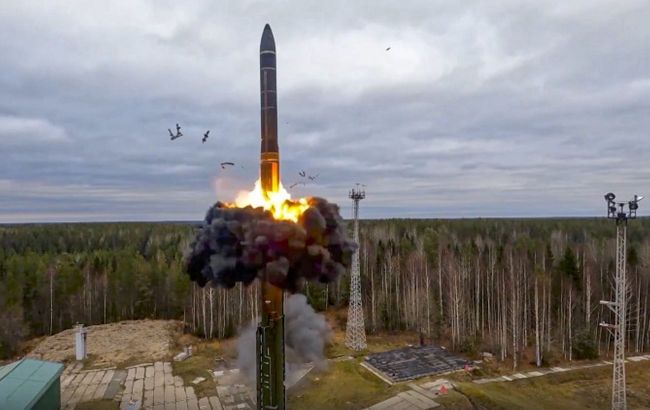 Illustrative photo: Ukraine twice knocked the Oreshnik missile off course using electronic warfare (screenshot from a video)
Ukrainian forces used the Lima electronic warfare system to throw two Russian Oreshnik ballistic missiles off course during the May 24 attack. As a result, neither missile hit its target, reports The New York Times.
The Lima system was developed to counter Russian missiles and drones. It emits electromagnetic interference that affects the navigation systems of weapons.
The system can transmit false coordinates, causing missiles and drones to change their trajectories and deviate from their intended routes.
Representatives of Cascade Systems, the company that manufactures Lima, and Ukrainian military personnel claim that the system is capable of affecting even Russian hypersonic missiles.
One of the most notable examples of its use was the May 24 strike.
According to soldiers from the Night Watch unit, Russia launched two Oreshnik missiles toward the Kyiv region at the time. One of the servicemen used the electronic warfare system to counter both targets.
As a result, the first missile fell near Bila Tserkva, in an area with garages, several miles away from any military facility. The second broke apart in midair, and its debris fell in the temporarily occupied part of the Donetsk region.
Russia also acknowledged that it had failed to hit any important targets during that attack. Russian president Vladimir Putin said that the Russian military had "simply struck where it was convenient to observe the results."
The operation of Ukrainian electronic warfare systems creates problems for civilian navigation. Due to the interference, GPS devices may locate people thousands of miles away from their actual positions.
For example, one taxi user in Kyiv was given a route home through South America, the Atlantic Ocean, and Europe. The app estimated the journey would take 12,276 minutes.
Meanwhile, the GPS watch of one Ukrainian government official showed that he had run more than six kilometers in Lima, the capital of Peru.
NYT journalists who traveled to inspect the system's antennas near Kyiv encountered the same disruptions: their car's navigation system also placed it in Peru.
The article notes that the military considers the benefits of operating Lima far more important than the inconvenience caused to civilians, as the system helps protect Ukrainian airspace from Russian weapons.
Oreshnik strikes
On the night of May 24, Russia used two Oreshnik ballistic missiles. One struck the Kyiv region, while the other fell in the temporarily occupied territories of the Donetsk region.
Russian propaganda claimed that the Oreshnik supposedly had enormous destructive power and could strike underground facilities. But research findings indicate the opposite.
The aggressor country may have begun low-rate production of the Oreshnik. But the total number of these weapons in Russia's arsenal remains minimal.