Myth of Oreshnik missile 'super-penetration' destroyed: What craters in Bila Tserkva reveal

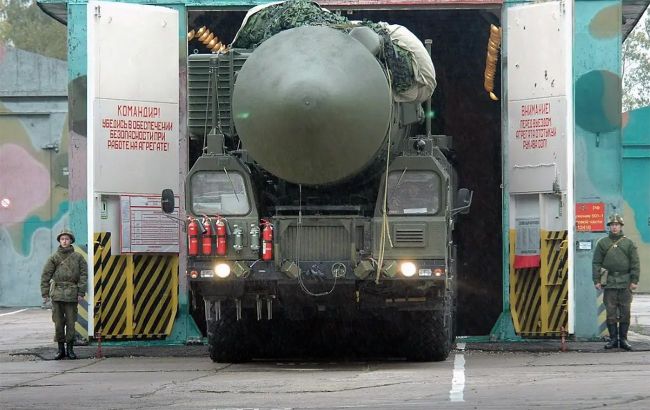 Photo: Oreshnik missile (Russian media)
Russian propaganda claimed that the Oreshnik has enormous destructive power and is capable of striking deeply buried targets. However, research shows a completely different picture, according to Defense Express.
Experts are already actively studying the impact site of the falling blocks of a medium-range ballistic missile (BRSD) Oreshnik, which the occupying forces used to attack Bila Tserkva on the night of May 24. The results of the inspection have helped debunk yet another Kremlin myth about this weapon.
Russian propaganda has long claimed that Oreshnik carries special tungsten kinetic penetrators designed for destroying deeply buried shelters, supposedly leaving almost no visible traces on the surface. However, journalists have obtained real measurements of the craters in ordinary soil:
- Diameter: approximately up to 3 meters;
- Depth: up to 2 meters.
Due to the enormous energy of impact, the blocks themselves experienced extremely fine fragmentation and were partially vaporized. This makes it impossible to accurately determine whether they contained tungsten "rods" or were simply mass-dimensional decoys.
However, the nature of the destruction of garages and the crater parameters fully match those previously recorded in Dnipro and Lviv — indicating no "new" type of warhead there.
Equivalent of the strike
According to preliminary estimates, the impact energy of the blocks at the moment of collision ranged from 220 to 400 MJ. Such kinetic energy can be roughly compared to a chemical explosion of 52–95 kg in TNT equivalent.
At the same time, the nature of energy release is fundamentally different: during a kinetic impact, there are almost no primary or secondary fragments that are typical of a high-explosive detonation.
Overall, the strike of an Oreshnik carrying 36 such blocks is, in terms of destructive power, roughly equivalent to a raid of 36 kamikaze drones of the Shahed type with an enhanced warhead.
On the night of May 24, Russia carried out a massive combined attack on Ukraine using drones as well as air-, sea-, and ground-launched missiles. The main direction of the attack was Kyiv.
During the strike, the enemy used the RS-26 Rubezh medium-range ballistic missile, known as Oreshnik. The launch was carried out from the Kapustin Yar range, and impacts were recorded in the Bila Tserkva area of the Kyiv region.