Ukraine faces new threat as Russia rolls out cheap jet-powered attack drone

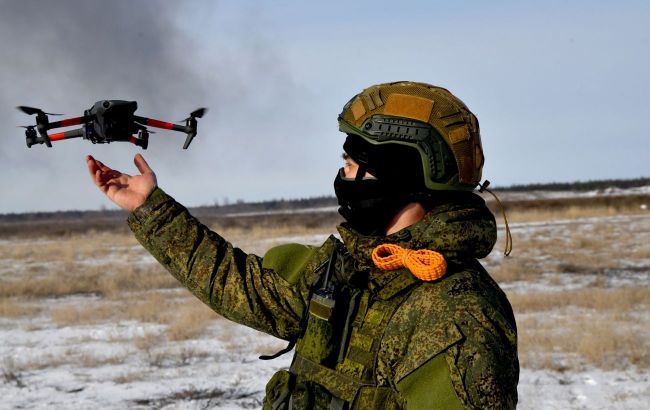 Russian soldier with a drone (Photo: Getty Images)
Ukrainian soldiers have spotted a new Russian weapon on the line of contact — a cheap jet-powered drone. Although it is still primitive, it has jet speed and is invisible to electronic warfare (EW) systems, according to a post by advisor to the Ukrainian Defense Minister and well-known drone expert Serhii "Flash" Beskrestnov.
Serhii described the concept of this drone as cheap and primitive. Interestingly, the drone transmits video on an analogue frequency of 3.3 GHz.
The combination of a jet engine and analogue video at 3.3 GHz in a cheap drone is a very dangerous technological step.
Why is the analogue frequency dangerous?
Most commercial and mass-produced military FPV drones operate on standard civilian frequencies. Analogue video usually operates at 5.8 GHz. Control most often occurs at 2.4 GHz or 915 MHz (in the ExpressLRS system).
Ukraine faces a new threat as Russia rolls out a cheap jet-powered attack dronehttps://t.co/EWZes92XHN pic.twitter.com/55NoT2bh9J
— RBC-Ukraine (@NewsUkraineRBC) June 16, 2026
Since these frequencies are known to everyone, trench and stationary EW systems are tuned to precisely jam these specific bands. When a drone uses a non-standard frequency of 3.3 GHz, the jammers simply don't see it or cannot block it, because their antennas and noise generators are designed for other wavelengths.
This creates a so‑called window of effectiveness until the Armed Forces of Ukraine adapt their EW to the new frequency. Furthermore, compared to the standard 5.8 GHz frequency, 3.3 GHz waves penetrate much better through tree foliage, bushes, light structures, and walls.
Communication will be more stable when the drone flies low over the ground (which is critical for FPV kamikaze drones on the final stretch of their trajectory). Also, with the same transmitter power, an analogue video signal at 3.3 GHz will reach further than at 5.8 GHz.
In addition, the digital signal from a standard Mavic (DJI) provides a clear picture, but at the cost of a delay in data transmission to the operator. Analogue transmits video instantly (almost zero latency), allowing the pilot to control the drone at speeds over 100 km/h.
What about the speed and warhead of the Russian drone?
Flash reports that the range of such a UAV can reach up to 100 kilometres (so far, strikes have been recorded at a distance of 30–40 km from the front line). Cruising speed is 260 km/h, with bursts up to 300 km/h. The warhead is approximately 4–5 kg.
The military officer writes that the Ministry of Defense is currently looking for an intact trophy of such a drone to disassemble and study its design. Flash also notes that the Russian occupiers are trying to use this UAV as a countermeasure against anti-aircraft drones and mobile fire groups.
What else is known about Russian drones?
Earlier, we reported on the Russian new loitering munition Banderol, which can fly up to 500 km and carry up to 150 kg of explosives. Ukraine's Defense Intelligence (HUR) experts have detected the use of foreign components in it.