UK and French paratroopers train for possible deployment to Ukraine

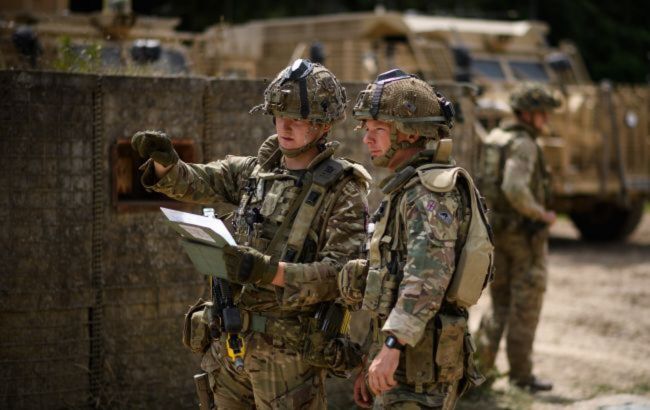 Photo: Exercise Orion set to conclude on March 3 (Getty Images)
British and French paratroopers have completed final preparations for a possible peacekeeping mission in Ukraine. They could be deployed if the country reaches a peace agreement with Russia, according to The Telegraph.
Read also: Ukraine open to sending forces overseas in future - Ukrainian Foreign Minister
According to the report, the drills in Brittany took place on February 24 and marked the final stage of preparations for paratroopers to deploy anywhere across NATO countries. The training forms part of Exercise Orion, which is set to conclude on March 3.
The activity followed comments by UK Prime Minister Keir Starmer that Britain and France would lead a peacekeeping force in Ukraine if a ceasefire agreement between Kyiv and Moscow is reached.
The Telegraph reported that more than 600 troops from the UK’s 16 Air Assault Brigade conducted a simulated raid alongside France’s 11th Parachute Brigade.
The composition of units that could be deployed to Ukraine has not been disclosed. However, the 16 Air Assault Brigade is among the UK’s high-readiness forces capable of rapid NATO deployment.
What Orion exercise involved
The UK Ministry of Defence said around 2,000 British and French personnel are taking part in Exercise Orion, a scenario focused on supporting a NATO ally facing insurgency and invasion threats.
The nine-day airborne drills began on February 24 with troops parachuting from RAF transport aircraft before securing positions and establishing defensive infrastructure.
During the exercise, forces practised repelling simulated attacks, conducting ambushes and launching offensive operations.
Under French command at Orléans-Bricy air base near Paris, British reconnaissance units and paratroopers carried out a covert insertion at the Saint-Cyr-Coëtquidan training area, neutralised simulated air defence assets and marked a landing zone for follow-on forces, including the 2nd Battalion of the Parachute Regiment.
An Italian parachute platoon also joined the scenario, after which an RAF A400M aircraft delivered supplies.
French General Renaud Ronde said the drills are crucial for testing new concepts and equipment, particularly hybrid communications networks and drone integration, stressing that rapid innovation and adaptation are key to battlefield advantage.
Challenges for UK deployment to Ukraine
President Volodymyr Zelenskyy recently said Britain and France committed to providing about 5,000 troops each for a potential contingent in Ukraine.
However, the UK faces challenges assembling such combat-ready forces, with the army reduced to roughly 70,000 personnel, its lowest level in more than 200 years.
Officials warned that meeting the target could require redeploying troops from Estonia and Cyprus to form a fully equipped brigade for Ukraine.
Armed Forces minister Al Carns said Britain has roughly three to five years before facing a major confrontation with a large state, adding the army must modernise faster after decades of limited structural change.
Coalition of willing
On February 24, Starmer announced increased support for Ukraine within the Coalition of the Willing, including a 70-person headquarters already operating and £200 million in UK-funded training.
UK defence secretary John Healey also said he wants to become the first minister to deploy British troops to Ukraine, describing such a move as a signal of the war’s end and a transition to peace.
French president Emmanuel Macron has previously said deploying coalition troops now would risk escalation and loss of control, explaining why such a step is not currently under consideration.