Trump's approval rating falls to lowest level of his presidency

 US President Donald Trump (photo: Getty Images)
US President Donald Trump has become the most unpopular US president in the past 16 years. His approval rating has fallen to its lowest level, The Economist reports.
According to the poll results, the approval rating fell to minus 24%.
Over the past week, the figure declined by another 1.9 percentage points.
Only 34% of Americans currently approve of the president's performance, while 58% express dissatisfaction with his policies.
Another 6% of respondents remain undecided.
As a result, Trump has become the most unpopular US president since 2009, when The Economist and YouGov began regularly tracking public opinion on American presidents.
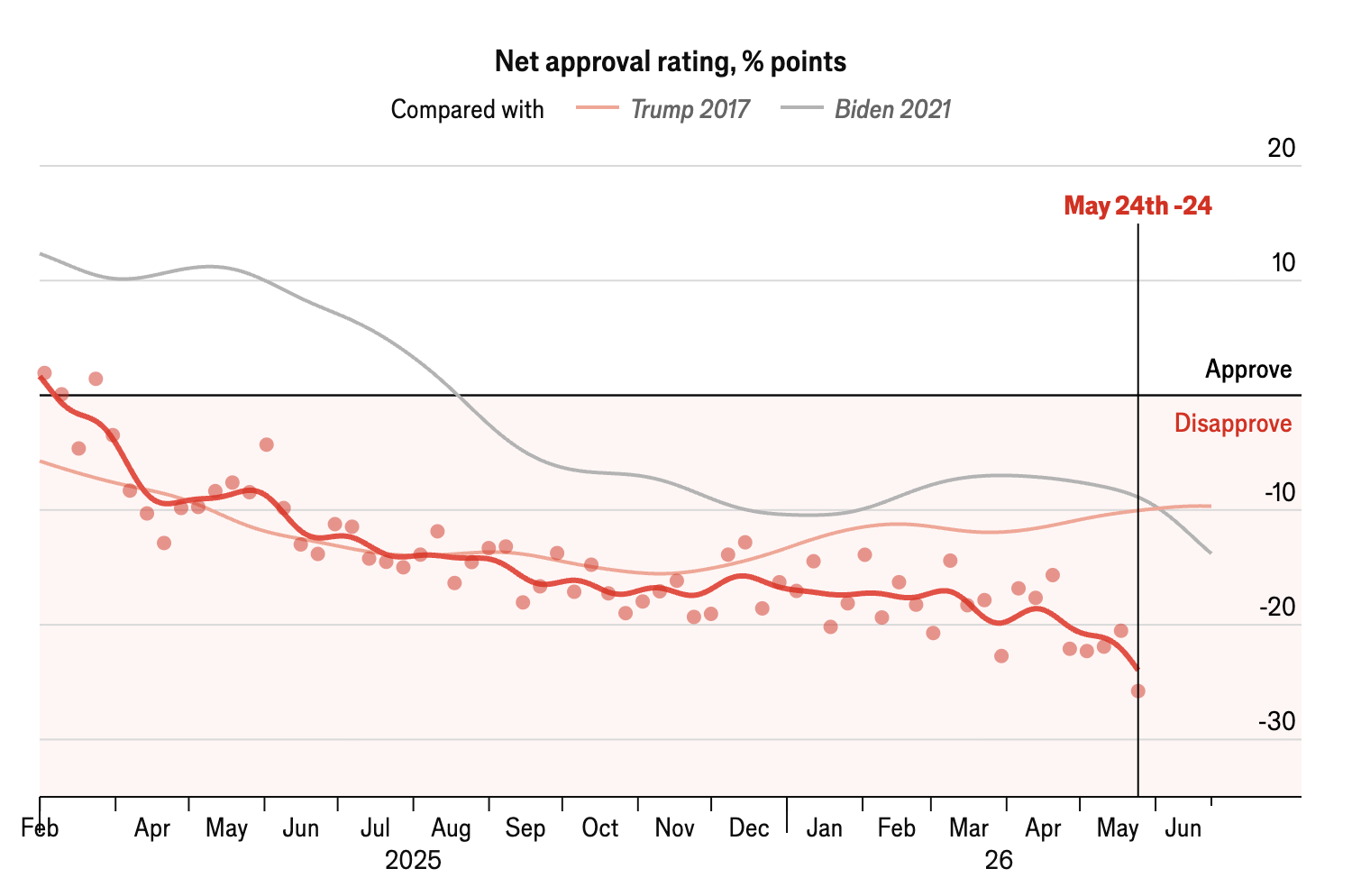 Donald Trump's net approval rating (photo: The Economist infographic)
Analysts cite two key factors behind the decline in his rating. The first is the war with Iran, which a significant share of Americans viewed negatively. The second, and more serious, is economic problems: assessments of the economy and the White House's handling of it had the greatest impact on the drop in support.
Pollsters also point to the geography of the dissatisfaction: the wave of negative sentiment has spread even to states that helped Trump win the 2024 election.
This may indicate a gradual loss of support not only among political opponents but also among part of his traditional electorate.
According to The Economist, the gap between the number of Americans who approve of Trump's performance and those who do not has become the largest of his entire presidency.
Trump's rating continues to decline
Trump's approval rating has been gradually declining since he took office in January 2025. At that time, he was supported by 47% of citizens.
According to the latest Reuters poll, Trump's approval rating has fallen close to its lowest level since his return to the White House — and the reason is not Democrats, but members of his own party.
Alongside declining ratings at home, Trump is also losing trust in Europe: 48% of Europeans describe him as an enemy of the continent.
The sentiment is strongest in Belgium and France, where 62% and 57% of respondents, respectively, hold that view. Such views are least widespread in Poland (19%) and Croatia (37%).