Trump administration freezes China hacker sanctions to protect truce - Media

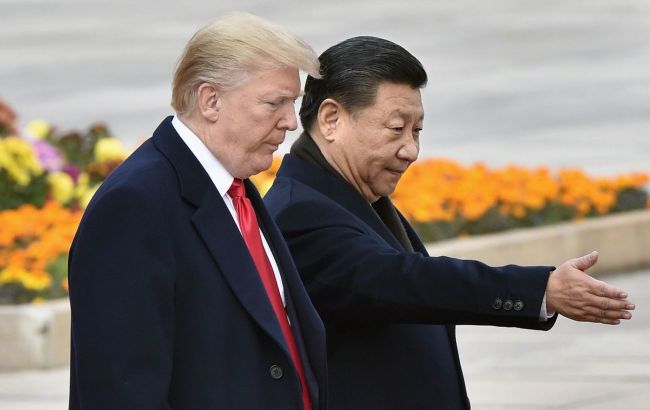 US President Donald Trump and China's leader Xi Jinping (photo: Getty Images)
The administration of US President Donald Trump has suspended plans to impose sanctions on China's Ministry of State Security. The sanctions were planned in response to espionage, but they could jeopardize the trade truce between the countries, the Financial Times reports.
Sanctions against China's Ministry of State Security were planned in response to a large-scale cyber-espionage campaign carried out by the Chinese. The network of Chinese hackers and their contractors was named Salt Typhoon.
However, due to the trade truce reached between US President Donald Trump and China's leader Xi Jinping in October, the plans to impose sanctions were suspended indefinitely. This could reportedly disrupt the easing of tensions between the countries.
Disappointment among hawks
In addition, the Trump administration abandoned new measures to control Chinese exports. For now, according to sources, the US administration's disorganized policy has stalled at the level of "stability" — at least until the United States reduces China's dominance in rare earth elements, which gives Beijing significant leverage over Western countries.
The White House decision sparked anger and disappointment among anti-China hawks in Washington. They are already saying that Trump is sacrificing national security for the sake of his questionable trade deals.
"The administration appears to be giving ground on export controls in order to secure President Trump's trip to Beijing and buy time to diversify critical mineral reliance away from China," Zach Cooper, an Asia security expert at the American Enterprise Institute, told the publication.
Anti-China politicians in the United States are also outraged that Trump may allow the sale of advanced chips to China, including Nvidia's Blackwell products. For now, advisers have persuaded Trump not to do so. But all tough actions and measures against China are currently on pause.
Meanwhile, in recent weeks, White House deputy chief of staff Stephen Miller has been instructed to ensure that agencies do not take actions that could disrupt this thawing of tensions. This has already prompted several complaints, while the Treasury Department and the White House are not commenting on the decision to impose sanctions on China's Ministry of State Security.
A trap for Trump
At the White House, one source said, they remain committed to establishing mutually beneficial trade relations with China without threatening national security. But experts have already warned that this may simply be a trap.
"The administration's rigorous export control regime, including on state-of-the-art Blackwell chips, remains in place, while China has agreed to crack down on fentanyl precursors, purchase US agricultural products, and keep rare earths flowing," the source told the publication, explaining the administration's behavior.
"Xi has a history of breaking promises to American presidents, and the Chinese Communist Party has a track record of exploiting negotiations to buy time strategically," said Michael Sobolik, an expert on US–China relations at the Hudson Institute.
Earlier, China suspended its ban on exporting gallium, germanium, antimony, superhard materials, and other rare-earth metals to the United States — a ban that had been in effect since December 2024.
In addition, on November 6, China suspended for one year the restrictions introduced in March on the supply of dual-use goods to 31 American companies, mainly from the defense and aerospace sectors. This happened after the meeting between US President Donald Trump and China's leader Xi Jinping in South Korea.