Taiwan orders huge batch of V-BAT drones proven in Ukraine to counter China

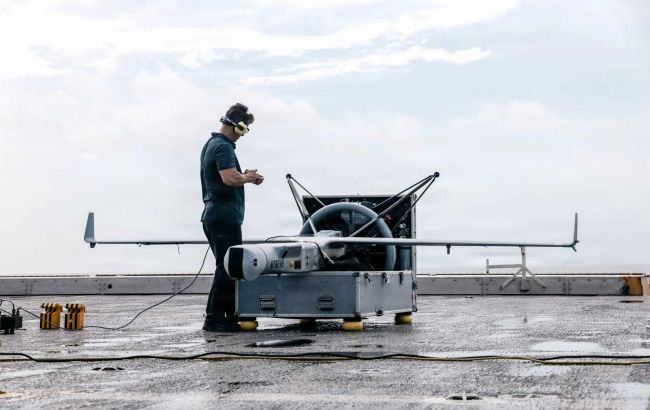 Photo: V-BAT drone (US Marine Corps)
By 2029, the Taiwanese Navy will receive 280 American V-BAT vertical takeoff and landing drones manufactured by Shield AI, according to Army Recognition.
How many drones will Taiwan receive, and when
Deliveries are spread over four years: 40 drones (14.3% of the order) in 2026, 110 (39.3%) in 2027, 64 (22.9%) in 2028, and 66 (23.6%) in 2029.
By the end of 2027, Taiwan will have 150 drones in service—more than half (53.6%) of the total order; the remaining 130 units will be delivered in 2028–2029.
Along with the drones, Taiwan will receive 140 control systems and 82 transport vehicles—two drones per control station and 3.4 drones per transport unit. At the same time, Taiwan is funding another program—the procurement of 32 Albatross II reconnaissance UAVs manufactured by NCSIST for 16.78 billion New Taiwan dollars.
Why Taiwan needs distributed drone network
The Taiwanese Navy plans to deploy V-BATs to surface combat groups and coastal defense units so that they have their own reconnaissance and target-acquisition capabilities, rather than relying entirely on coastal radars, airfields, or large manned aircraft.
What matters is not only the number of drones but also the amount of supporting equipment purchased, which allows the drones to be deployed as mobile units across the fleet and along the coast, rather than being operated from a single centralized base.
The V-BAT, also known as the MQ-35A, is a 75-kg tailsitter drone with a wingspan of 3.8 m and a height of 2.9 m, capable of a maximum speed of 90 km/h and a service ceiling of 5,486 m.
What changed in new version
The Block 5.3 configuration, introduced in April 2025, replaced the gasoline engine with a 33-hp heavy-fuel engine compatible with JP-5, an aviation fuel typically carried on board military ships, which simplifies maintenance within the fleet.
This same update increased the maximum payload from 11.3 kg to 18.1 kg (an increase of 6.8 kg, or 60%), and larger fuel tanks extended the flight duration with an op-elec payload to over 12 hours.
This increase in payload capacity is significant because 18.1 kg allows for the installation not only of a single optical turret but also of combinations of communications, radar, navigation, target acquisition, or electronic intelligence equipment within the limits of the aircraft's available weight and power.
With satellite communications and a payload of 9.1 kg, the stated one-way flight range reaches 648 nautical miles (1,200 km)—this is not a combat radius, since a real maritime mission must account for fuel for the outbound flight, patrolling, return, and a reserve, but the figure demonstrates the aircraft’s ability to trade patrol time for flight range.
How drone is controlled
For close-range control, relay radio communication provides line-of-sight capability up to 139 km, while phased-array antennas extend this range to 180 km; satellite communication enables control beyond line of sight.
At least two operators can set up and prepare the drone for flight in less than 30 minutes, and a vertical landing requires a landing area of approximately 4.6 by 4.6–4.7 meters—this allows the drone to be operated from a ship's deck, a coastal road, or any other small cleared area without a runway, catapult, or aerostat cable—all of which are required for larger, aircraft-type unmanned aerial vehicles.
The payload suite extends beyond purely optoelectronic surveillance: available options include EO/IR turrets, synthetic aperture radar, an Automatic Identification System (AIS), a ViDAR system, satellite communications, GNSS anti-jamming equipment, M-code GNSS, laser rangefinders, laser designators, and electronic intelligence systems—in total, the drone is capable of delivering up to 600 watts of power to the payload.
How V-BAT was tested in Ukraine
Ukraine provided a concrete example of V-BAT's use in conditions where satellite navigation and communications are actively jammed. The drone began combat testing there in June 2024—against Russian forces that were extensively using GPS jamming and electronic warfare systems to suppress communications.
During an experiment in August 2024, V-BAT drones located the positions of Russian anti-aircraft missile systems and transmitted targeting data, which was subsequently used for HIMARS strikes.
In one of its missions, the drone operated at a distance of about 100 km beyond the front-line electronic warfare zone, searching for a mobile Buk-M1 surface-to-air missile system—that is, it was not used for close-range reconnaissance over friendly positions, but was deployed beyond the main electronic warfare zone to search for a moving air defense target that could itself pose a threat to larger reconnaissance drones.
The V-BAT navigation architecture includes visual odometry, which allows the drone to estimate its own position without a continuous GPS signal.
This is directly relevant to target designation: a drone that has detected a Buk launcher but has lost confidence in its own coordinates cannot reliably provide data accurate enough for a long-range retaliatory strike.
The Hivemind autonomy system includes status assessment, mapping, target tracking, mission planning, behavior, and navigation—this reduces the amount of manual control that would otherwise have to be transmitted via a potentially jammed radio channel.
Stellarion has received Department of Defense (DoD) codification for its Deadliner Q15-30 fiber-optic FPV drone, which has a range of up to 30 km, a payload capacity of up to 3 kg, and a flight time of at least 30 minutes.
Following certification, the model will be available for order by Ukrainian Defense Forces units through Brave1 Market and DOT-Chain. According to the manufacturer, the company is simultaneously preparing Deadliner versions with ranges of 35 and 40 km for certification to expand the selection of drones for various combat missions.