Scientists reveal what caused the worst year in human history

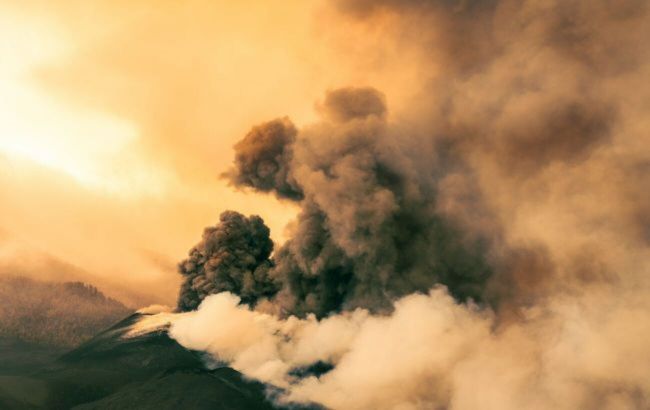 The dark age lasted for nearly a century (photo: Pexels)
The year 536 may have been the worst year in human history. New research suggests that massive volcanic eruptions plunged the planet into prolonged cooling, triggering famine and disease, according to Futura.
In 536, an abnormal dimming of sunlight was observed across Europe, the Middle East, and parts of Asia.
According to the writings of Byzantine historian Procopius of Caesarea, "the sun gave forth its light without brightness, like the moon, during the whole year." The climate changes brought summer snowfall to China and caused widespread crop failures across vast areas.
Modern tree-ring studies and analysis of ice cores confirm that large amounts of volcanic ash and sulfur were released into the atmosphere, causing the phenomenon.
Volcanic winter, natural anomalies
Studies of ice cores from glaciers in Greenland and the Alps have revealed microscopic particles of volcanic glass whose chemical composition is similar to that of rocks from Icelandic volcanoes.
Additional eruptions, including that of the Ilopango volcano in what is now El Salvador around 539-540, further intensified the atmospheric dimming.
The resulting dust veil reflected sunlight, with long-lasting consequences:
- Average summer temperatures in Europe fell by 1.5-2.5 degrees Celsius
- Northern Hemisphere entered its coldest period in the past 2,000 years
- Tree rings became significantly narrower, indicating a severe decline in plant growth.
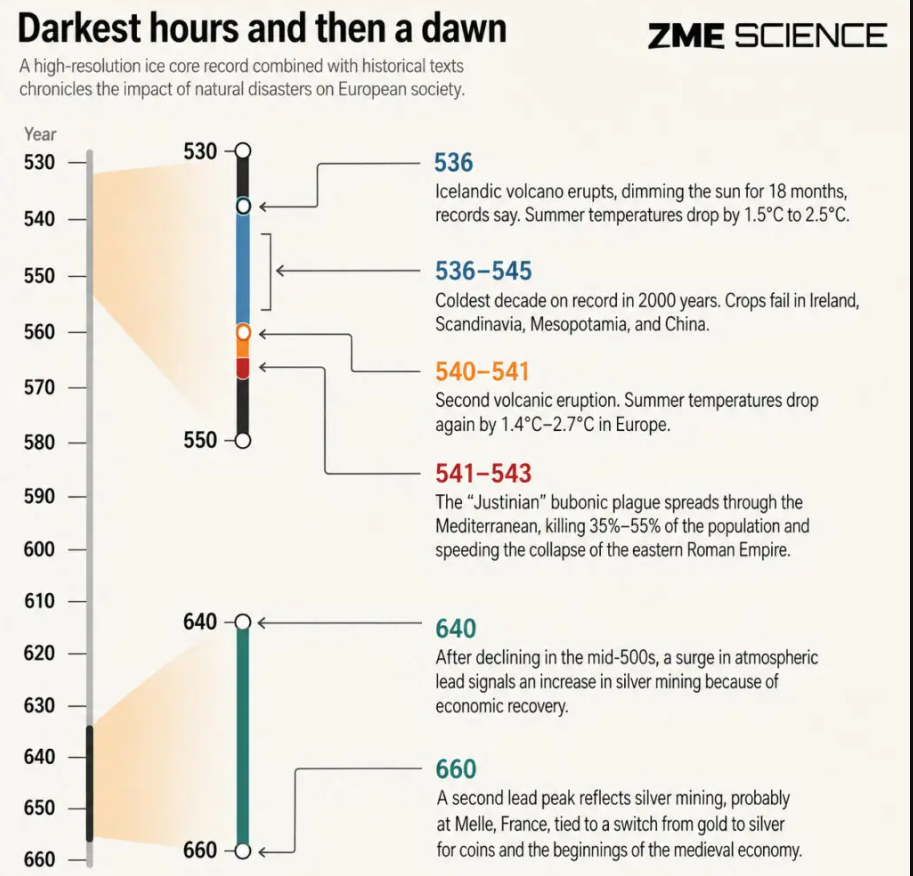
Scientists have mapped the chronology of catastrophes triggered by a volcanic eruption at the beginning of the Common Era (photo: ZME Science)
Social and economic consequences
Prolonged crop failures caused famine, weakening the population and lowering immunity.
By 541, bubonic plague, known as the Plague of Justinian, had reached the Mediterranean. The epidemic swept through the Byzantine Empire and neighboring regions, causing high mortality and a deep economic crisis.
Analysis of glacial ice shows that economic recovery and the revival of silver mining in Europe did not begin until around 640, nearly a century after the climate catastrophe began.