Scientists identify critical flaw in using nuclear strikes to deflect asteroids

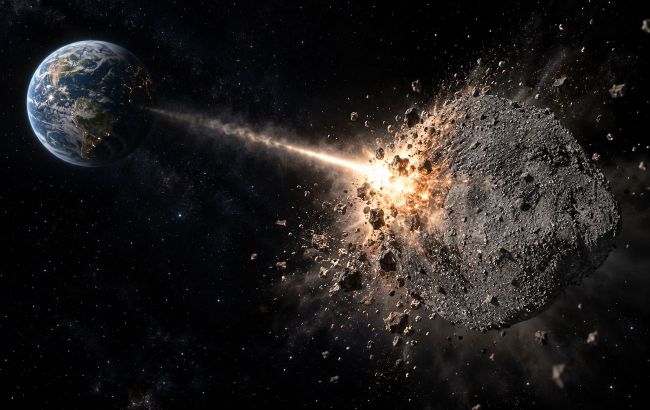 Targeting the wrong side for a nuclear strike could jeopardize Earth's salvation (image: RBC-Ukraine)
A nuclear explosion could save Earth from a collision with a hazardous asteroid, but an ill-directed strike could only worsen the situation. Physicists have determined that the effectiveness of such a defense depends on the shape of the celestial body and which side is targeted, according to a study published in the scientific journal Icarus via ScienceDirect.
Why does the asteroid's shape drastically change the impact results?
Scientists explain that in previous models, asteroids were usually depicted as perfect spheres to simplify calculations. However, real celestial bodies have uneven surfaces and complex shapes.
Using a new algorithm, researchers were able to model in detail how X-ray radiation affects different areas of such asteroids.
The results were unexpected: for one of the test asteroids, the deflection velocity from its previous trajectory was 3.9 millimeters per second when struck from one side, and only 0.8 millimeters per second when targeted at another area.
In the case of another object, the rotation speed after the explosion differed by a factor of seven. This difference proves that an error in target selection could reduce the effectiveness of saving the planet.

Pressure distribution, averaged over the first 20 microseconds of vapor expansion, for asteroids (a) Bennu, (b) Itokawa, and (c) Golevka (source: Icarus (2026). DOI: 10.1016/j.icarus.2026.117364)
Read more: Zero evacuation time: Scientists simulate nuclear blast on asteroid
How complex is the implementation?
Researchers emphasize that the primary goal of a nuclear impact on an asteroid is to gently nudge the hazardous object, not to shatter it into potentially dangerous fragments.
The computer model created by the scientists allows for the generation of surface vaporization heat maps, calculation of impulse force, rotation speed, and the probability of local destruction based on 3D images obtained during spacecraft flybys.
Although precisely targeting a charge at a fast-moving asteroid and thoroughly surveying its entire surface in advance remains challenging, the new model helps better predict the consequences of such an intervention.
It provides scientists with a tool to optimize planetary defense missions, ensuring that humanity has a better chance of avoiding a potential catastrophe.
More interesting: