Scientists explain why nuking asteroid is necessary last-resort option

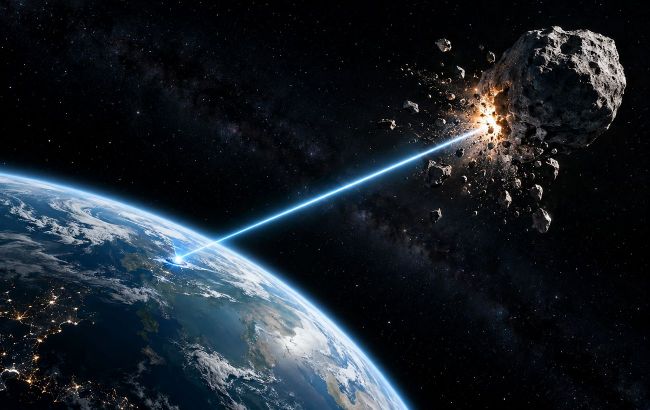 3D model shows how to save Earth (image: RBC-Ukraine)
Scientists have modeled how a nuclear explosion could alter the trajectory of a dangerous asteroid or destroy it. Researchers at LLNL created 3D simulations demonstrating how X-ray radiation causes evaporation and fragmentation of the celestial body, according to Interesting Engineering.
When will a standard impactor not help?
Unlike most global threats, a collision with an asteroid can be prevented if it is detected in advance.
In 2022, NASA already tested a kinetic impactor during the DART mission by deliberately crashing a probe into the asteroid Dimorphos and changing its orbit.
However, stopping giant asteroids or acting when only months remain before a potential impact would require more force than a conventional spacecraft can provide.
Inspired by this challenge, scientists at the Lawrence Livermore National Laboratory developed an alternative plan for extreme emergencies—a nuclear explosion capable of transferring significantly more energy to the object.
To assess the realism of such a scenario, astrophysicists used the specialized Spheral code.
First, they compared over 1,500 one-dimensional calculations with data from the validated Ares model, and after confirming accuracy, proceeded to volumetric 3D simulations.
What happens during the explosion?
For the experiment, scientists modeled a detonation near a complex-shaped asteroid with a diameter of 160 meters. During the simulations, they varied both the distance to the detonation site and the density of the rock itself.
The results were convincing:
- Over 98 percent of the asteroid's matter suffered critical damage, completely losing its monolithic structure.
- Nearly 97 percent of the mass accelerated to speeds exceeding the object's own gravity.
- Most of the debris scattered in opposite directions—indicating that the celestial body broke apart into small fragments.
Don't miss: AI and nuclear war aren't only dangers: Scientists warn of 17 threats to humanity
What does this change for saving Earth?
The main conclusion of the study is that after the detonation, the asteroid fragments move with sufficient speed to disperse into open space.
As a result, none of the fragments would threaten Earth in the form of a massive "stone rain."
The obtained 3D models will provide international planetary defense organizations with clear mathematical calculations on how, where, and with what power a nuclear charge should be used if the planet truly faces a cosmic catastrophe.