Zero evacuation time: Scientists simulate nuclear blast on asteroid

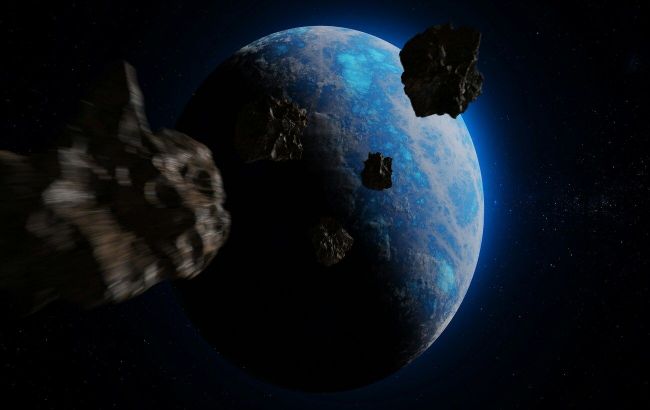 Scientists prepare a nuclear protocol for Earth’s defense (image: Javier Miranda)
A nuclear explosion could save Earth from an asteroid - Chinese researchers have modeled such a planetary protection scenario, according to Futura.
According to NASA, up to 15,000 undetected asteroids several hundred meters in size may be hiding in near-Earth space. Each of these objects is capable of completely destroying a large city.
Essence of the method and scientists' calculations
The main danger lies in the warning time.
In the event of a sudden threat detection, the window for response may be only a few days or weeks. In such a short period, it is impossible to organize an evacuation or build complex spacecraft to alter the object's orbit.
Researchers modeled a situation where an asteroid is moving toward Earth at a speed of about 10 kilometers per second.
What would happen in such a scenario?
Instead of detonating a device next to the object, they propose embedding a nuclear charge directly into its body.
An internal explosion should completely pulverize the celestial body rather than just changing its trajectory.
The calculations require using explosive force that exceeds the power of the bomb dropped on Hiroshima in 1945 (15 kilotons) by many times.
Technological obstacles and prospects
The authors of the scientific paper acknowledge that there is still a huge gap between the computer model and real-world capabilities.
Currently, humanity does not have spacecraft capable of quickly drilling into an asteroid's surface and planting explosives.
The current standard for planetary defense is NASA's DART mission, which in 2022 changed the trajectory of the asteroid Dimorphos through a kinetic impact. However, this method is suitable only for deflecting objects when there is sufficient lead time.
Despite this, the new study creates a foundation for developing a unified international action protocol. In the future, these calculations are planned to be integrated with new early threat detection systems, including NASA's NEO Surveyor mission.
More interesting: