Russian Oreshnik missile launched at Ukraine shows Belarus connection

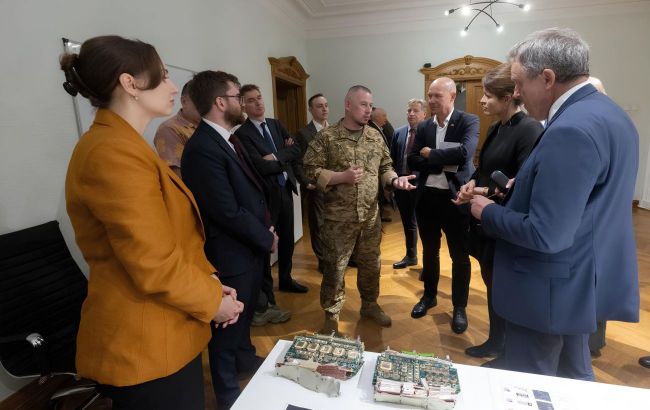 Photo: Putin's ally helps build missiles (president.gov.ua)
The components of the Oreshnik missile, which Russia used to strike Ukraine on May 24, were manufactured at a plant in Belarus. EU ambassadors were shown the inner workings of the new Russian missile, according to the Office of the President of Ukraine.
What ambassadors were shown
A meeting with ambassadors from European countries took place in Kyiv. It was attended by Pavlo Palisa, Deputy Head of the Office of the President of Ukraine; Vladyslav Vlasiuk, the President’s Representative on Sanctions Policy; and representatives of the Security Service and the Office of the Prosecutor General.
The ambassadors were shown actual parts from the missiles and drones that Russia used to attack Ukraine on the night of May 24. Specifically, fragments of Zircons, Kalibrs, Kh-101s, and Geran-2 drones were displayed.
Components from Switzerland, Germany, the US, the UK, Japan, China, and other countries were found in these weapons, some manufactured this year.
Separately, the ambassadors were shown circuit boards from the Oreshnik. There, the picture is different.
Belarusian trace in Oreshnik
Circuit boards from the Oreshnik contain exclusively Russian and Belarusian components manufactured between 2004 and 2014. Some of them were made at the Integral plant in Minsk. These include microchips and circuit boards for cruise missiles and the Oreshnik.
Vlasiuk emphasizes that Belarus still has access to foreign electronics, and this channel must be cut off.
Vladyslav Vlasiuk calls for a halt to the supply of components to Russia.
"We need to focus and actually stop the supply of parts going to Russia. This will deal a significant blow to Russia’s military production capabilities," he says.
Pavlo Palisa appeals to diplomats to strengthen existing sanctions and accelerate work on new packages.
"You know that Russia is saying they are ready to launch more missiles to strike targets in Ukraine, especially in Kyiv. Everyone has seen the results. This is not about any so-called ‘decision-making centers,’ as they claim; this is about civilians, about civilian casualties," he says.
Palisa notes that this is not about decision-making centers, as Moscow cynically claims, but about attacks on civilians.
"They are not capable of carrying out such strikes on their own, without assistance or an industrial base from other countries," he emphasizes.
The question of whether the Oreshnik contains any foreign components at all has arisen before. Vladyslav Vlasiuk suggests that, unlike other missiles, this one might not contain any foreign-made parts.
During the attack on May 24, Russia launched two Oreshnik missiles. One of them struck the Kyiv region; the fate of the second became known from a letter from Ukrainian President Volodymyr Zelenskyy to U.S. President Donald Trump. It turned out that the missile fell in the occupied part of the Donetsk region.