Russia uses online gambling to make money in occupied territories of Ukraine

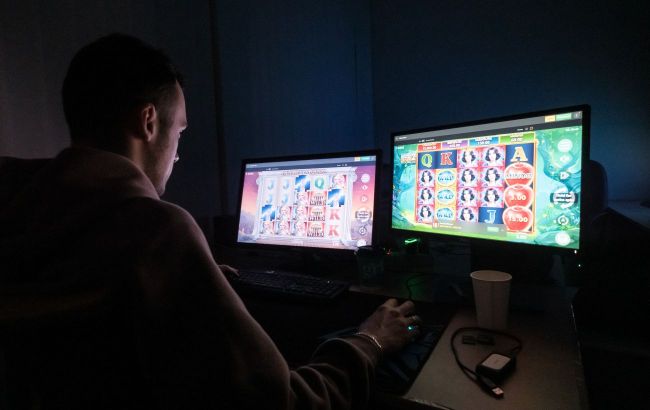 Online casino (Illustrative photo: Vitalii Nosach, RBC-Ukraine)
Russia, together with Russian administrations, is launching online casinos in temporarily occupied territories, using them as a new source of revenue, according to the National Resistance Center (NRC).
While officially presented as economic regulation, in reality, the initiative is a means of extracting funds from the occupied regions to finance the war.
The idea is being promoted by Russian Finance Minister Anton Siluanov, and the gambling business is becoming part of a system enriching the Russian authorities, the Center noted.
Financial flows from temporarily occupied territories are controlled by Russian Finance Ministry structures in coordination with the Kremlin administration, with political oversight provided by First Deputy Chief of the Presidential Administration Sergey Kiriyenko, according to analysts at the National Resistance Center (CNR).
Through this system, decisions are made to launch gray revenue sources, allowing Russia to generate funds in ways that bypass sanctions and avoid transparent reporting.
Under this scheme, at least 30% of online casino revenues are automatically seized by Russia. All payments go through Russian payment systems, making the funds easy to monitor: some remain in shadow budgets of the occupation administrations, while the rest is transferred to Moscow, the Center noted.
“Effectively, legalizing casinos in occupied territories is another element of a centralized model for exploiting these regions. Under the guise of уconomic measures, gambling is turned into a tool of war financing, channeling civilian funds to support the occupation regime under direct Kremlin control,” the analysts concluded.
Other sources of revenue in occupied territories
Earlier, RBC-Ukraine reported that Russian authorities in Luhansk are selling off property.
Russian structures in Luhansk officially acknowledged a cash shortage and announced a large-scale privatization program.
The sale of assets is described as spending optimization, but the stated figures and mechanisms indicate the urgent nature of these measures and the lack of stable revenue sources. The minimum plan aims to generate at least 120 million rubles.
Meanwhile, in temporarily occupied Donetsk, non-payers of loans are being forced to join Russia’s war effort.
This conscription applies not only to unpaid loans but also to fines, penalties, and other financial obligations that individuals cannot meet.
As a result, a system is emerging in temporarily occupied Donetsk in which citizens are treated not as people with rights, but as a resource for debt.