Russia forces foreigners toward war against Ukraine with deportation threat

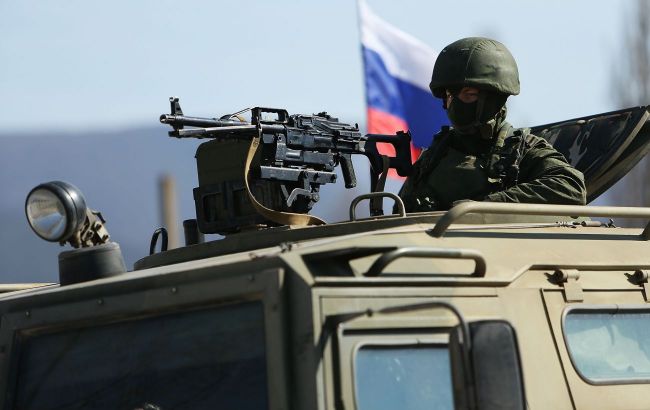 File photo: Russian soldiers (Getty Images)
Russian authorities have implemented a cynical scheme to replenish losses on the front lines. Instead of open conscription, which has sparked protests in Asian and African countries, Russia has launched a large-scale campaign to pressure migrants, according to the Foreign Intelligence Service of Ukraine.
Against the backdrop of colossal losses in Ukraine, the Kremlin can no longer rely solely on its own mobilization resources. And no wonder: since most countries in the world have officially banned their citizens from participating in the war against Ukraine, Moscow has resorted to a tactic of migration terror.
"Amid significant losses in Ukraine, the Kremlin has turned to a new source of recruits: migrants residing in Russia without citizenship. Since most countries in Asia, Africa, and Latin America officially oppose the recruitment of their citizens into the russian army, Moscow has chosen a workaround – artificially creating conditions under which staying in the country without a Russian passport becomes practically impossible," the official statement reads.
The essence of the scheme is simple: foreigners without a Russian passport are subjected to artificially created, unbearable living conditions. Thus, now any minor error in documents leads to deportation, and the only alternative to expulsion is signing a contract with the Russian Armed Forces.
Statistics as tool of pressure
According to the Security Service of Ukraine (SBU), the Russian Ministry of Internal Affairs shows abnormal spikes in the numbers of deported foreigners: in 2024 alone, over 157,000 people were forcibly removed from Russia (45% more than the previous year).
In 2025, the number of those officially deported fell to 72,000, but the reason was not humanitarian.
Russian Interior Minister Kolokoltsev openly admitted: "We could have deported 10 times as many, but we lack funding." It is precisely those for whose deportation there were insufficient funds that the Kremlin plans to send en masse to the front lines.
Extremism for social media post: New legal pitfalls
To expand the pool of potential recruits, Russian authorities are even preparing amendments to the Code of Administrative Offenses.
Now, a foreigner can be expelled from the country (or sent to the front lines) for:
- violating religious laws;
- abuse of freedom of speech;
- spreading extremist content on audiovisual platforms.
It turns out that, in effect, any like or comment by a foreigner could become grounds for blackmail: either prison and deportation, or an assault unit near Bakhmut or Avdiivka.
Passport at cost of one's life
The Kremlin is counting on migrants seeking to protect their families and legalize their status to voluntarily choose military service.
Formally, this is obtaining citizenship through a simplified procedure; in reality, it is the use of foreigners as cannon fodder to buy time before the next wave of mobilization among ethnic Russians.
Ukrainian intelligence emphasizes that there is no voluntary choice here. This is coercion disguised as bureaucratic procedures, where the price of a Russian passport is the life of a citizen of another state in a war of aggression.
Incidentally, the Russian command plans to deploy all mobilized personnel currently stationed in the temporarily occupied Crimea to combat operations. According to available information, Russia intends to transfer these troops to the front lines starting April 1. To reinforce the units, the deployment of marines and paratroopers is also planned.
In this way, Russia is attempting to make up for its losses and reinforce its forces along the front lines.
Russian troops have likely launched a spring-summer offensive against Ukraine’s belt of fortresses in the Donetsk region.