Russia could put nuclear weapons in orbit, German commander says

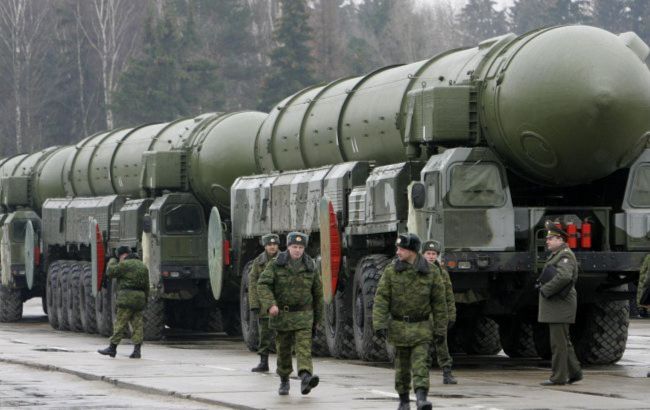 Berlin raises concerns over Russia's suspected nuclear plans in space (photo: Russian media)
A nuclear explosion in space could disable up to one-third of satellites in low Earth orbit, according to Major General Michael Traut, commander of the Bundeswehr Space Command.
Suspicions of nuclear device in space
General Traut assessed the possibility that Russia could develop nuclear weapons in space as an extreme escalation scenario.
"At the very top end of escalation, there is the suspicion that Russia may be working on technology to place a nuclear explosive device in orbit," he said.
When asked whether he considers such a scenario realistic, the commander replied: "I cannot rule it out."
Consequences for satellites and orbit
The major general says a nuclear explosion in space would not resemble a conventional strike on Earth, but its consequences could be devastating for modern societies and militaries that rely on satellites for communications, navigation, banking, transportation, weather forecasting, and military targeting.
"If something similar to Starfish Prime happened today, up to one-third of all satellites in low-Earth orbit could stop functioning over the following weeks and months," Traut said, referring to the US high-altitude nuclear test in 1962.
He added that such an event would worsen the space debris problem and increase the risk of cascading collisions, known as the Kessler syndrome.
"It is even conceivable that certain orbital altitudes would no longer be usable for decades," Traut warned.
Current threats: Jamming, lasers, physical attacks
The Bundeswehr commander noted that threats in space have "massively developed" in recent years—from GPS jamming and lasers to physical attacks on satellites.
Electromagnetic interference and laser attacks are already a daily reality at a lower level of escalation.
"The best example is GPS jamming in the Baltic region," Traut said, adding that it affects civilian aviation and maritime traffic.
German space strategy
The top commander says Germany's response cannot be purely defensive.
"You don't go into the arena only with a shield. A functioning deterrent always has an active, offensive component," he emphasized.
The general clarified that "offensive does not mean aggressive," but that Germany must be able to seize the initiative in a conflict. This includes actions against adversary space systems—not necessarily in orbit, but across the entire infrastructure that enables satellites to function, from ground stations to jamming systems.
The Bundeswehr plans to acquire:
- Non-kinetic systems, including jammers and lasers
- Inspection satellites
- In the long term, spaceplanes to protect German satellites, inspect hostile systems, and potentially act against them.
Berlin also plans to create a sovereign military satellite communications constellation under the SATCOMBw 4 program, intended to meet the Bundeswehr's growing demand for secure connectivity.
Traut stressed that the program will not compete with the EU's secure communications system IRIS².
"We do not see IRIS² as competition, but as a complementary addition," the commander said.
According to him, Germany's own constellation will reduce pressure on the EU system and free up more capacity for others.
Berlin also plans to involve as many European partners as possible in the network, especially countries that cannot or do not want to build their own satellite constellations.
Earlier, US intelligence warned allies that Russia may deploy nuclear weapons in orbit, with agencies suggesting Moscow could even launch a "dummy" warhead to keep Western countries uncertain about its real capabilities.
Based on intelligence assessments, Russia is also working on a satellite capable of carrying nuclear weapons intended for use against other satellites.