Russia claims participants in its special military operation aren’t POWs - Ombudsman

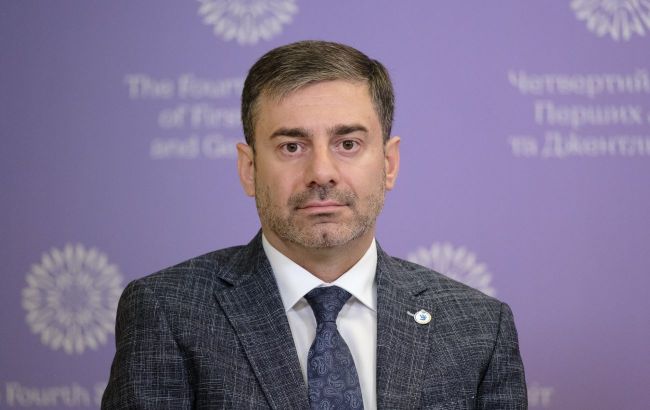 Photo: Ukraine’s Parliamentary Commissioner for Human Rights Dmytro Lubinets (Vitalii Nosach, RBC-Ukraine)
Russians raised the issue that Russia has not declared war on Ukraine but is conducting a special military operation, and therefore, all those fighting as part of this special operation are allegedly not prisoners of war, states Ukraine’s Parliamentary Commissioner for Human Rights Dmytro Lubinets during a national telethon live broadcast.
According to him, there are many legal nuances that Russia uses in an attempt to evade compliance with the Geneva Conventions.
"For example, they repeatedly raise the issue that they are not at war, that no war has been declared against Ukraine, that this is a special military operation, and therefore all those fighting as part of this special operation are allegedly not prisoners of war at all. And such claims have been made," Lubinets said.
He noted that this is precisely why the Ukrainian side has repeatedly pointed out, on legal grounds, that there can be no dual interpretation when, for example, a prisoner exchange procedure is being carried out.
"This is a direct mechanism prescribed by the Geneva Convention. Accordingly, the Russians automatically acknowledge that Ukrainians are prisoners of war and combatants. Consequently, all the rights of prisoners of war must automatically be protected under international humanitarian law," the ombudsman emphasized.
He also said that during a recent meeting with the Russian side, he was asked, among other things, for the Ukrainian side to visit Russian prisoners of war.
"This is a two-way process. If they committed to transferring two thousand parcels for Ukrainian prisoners of war, then I automatically took on the obligation to deliver two thousand parcels to Russian prisoners of war. My task is to ensure an absolute balance: if such treatment of Russians in Ukraine is based on international humanitarian law, then the same treatment must automatically be ensured on Russian territory for Ukrainian prisoners of war," Lubinets said.
He also stressed that it is important for the Ukrainian side that representatives of the International Committee of the Red Cross physically visit Ukrainian prisoners of war, see the conditions of their detention, and communicate with them.
Prisoner exchanges
In November, Ukraine’s National Security and Defense Council Secretary Rustem Umerov announced the resumption of prisoner exchanges between Ukraine and Russia. About 1,200 Ukrainians are expected to be released from Russian captivity.
According to him, following consultations in Türkiye and the United Arab Emirates, the parties agreed to activate the Istanbul agreements to carry out the exchanges.
The most recent exchange took place in early October, when 185 Ukrainian defenders returned home, including National Guard members who had defended the Chornobyl Nuclear Power Plant. The youngest of those released was 26, and the oldest was 59.
That prisoner exchange between Ukraine and Russia was a combined one. One part was conducted under the Istanbul agreements, while the other was a separate, 69th exchange.
The Coordination Headquarters for the Treatment of Prisoners of War also said it is currently working in two directions: exchanges based on the Istanbul agreements and so-called numbered exchanges.