Qatar talks show progress despite Iran's refusal to meet directly, US says

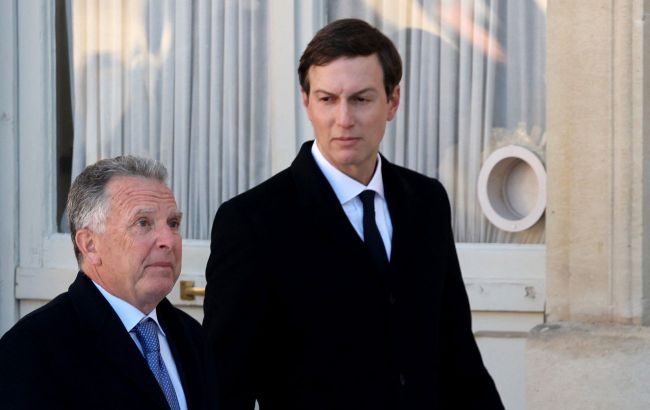 US negotiators Steve Witkoff and Jared Kushner (photo: Getty Images)
The US side reported positive talks in Qatar with regional leaders, while technical negotiations with Iran are moving forward, a senior US administration official said, according to Bloomberg.
According to the unnamed official, US negotiators Jared Kushner and Steve Witkoff held positive talks with regional leaders in Qatar, while technical negotiations with Iran are moving forward as the countries seek to ease tensions after the recent escalation.
The media outlet recalls that the two Americans were in Doha as part of ongoing indirect talks between the US and Iran aimed at reaching a long-term peace agreement.
What preceded this
A temporary agreement signed earlier this month opened the way for a 60-day negotiation period, but these efforts suffered a setback in recent days after a series of clashes over events in the Strait of Hormuz.
Witkoff and Kushner returned to Doha for talks after the US and Iran agreed to halt their renewed attacks.
"Still, the uncertainty hanging over their discussions highlighted the delicate nature of the talks and the complicated path ahead for both Washington and Tehran as they look to broker a broader accord," Bloomberg notes.
Expectations from the talks and reality
The article says that Qatari officials downplayed expectations for the new talks, saying that President Donald Trump's top envoys would not meet directly with their Iranian counterparts.
A senior administration official, who requested anonymity to provide an update on the course of the discussions, said that progress continues in separate technical talks being conducted by lower-level representatives.
The Wall Street Journal, citing unnamed US officials, reported on Tuesday evening that Trump had decided not to resume a broad military campaign and told his staff that he had no objection if the talks continued beyond August 18.
Unresolved issues
Among the main unresolved issues are the release of billions of dollars in Iranian assets and the future governance of the strait through which about one-fifth of the world's oil and liquefied natural gas supplies passed before the war.
Iran insisted that it would have a certain degree of control over maritime traffic through the waterway. It indicated that some vessels might have to pay transit fees, raising the stakes in the negotiations.
Any proposal to introduce such a fee has faced strong opposition from the US, Europe, and most Arab Gulf states.
Terms of the temporary agreement
The temporary agreement stipulates that Iran will not impose duties for 60 days, but leaves open the possibility that vessels could be required to pay certain fees after that period.
The Iranian side refused to hold direct talks with Witkoff and Kushner in Doha and outlined its conditions, including an agreement on implementing the ceasefire in the Strait of Hormuz.
On June 29, the United States and Iran had reached an agreement to immediately halt mutual attacks and begin negotiations scheduled for June 30.