Putin’s allies complain that he has abandoned them for sake of war against Ukraine - Bloomberg

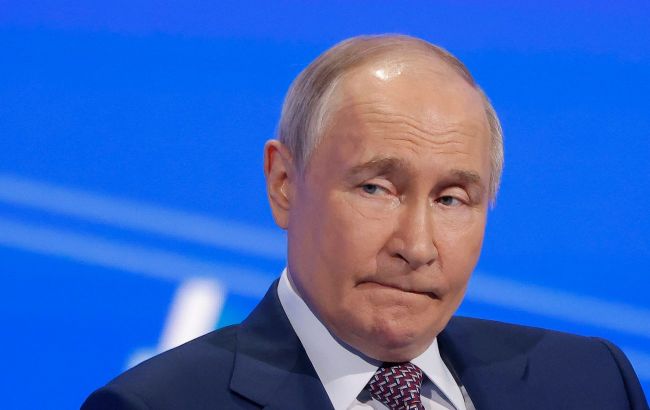 Photo: Russian President Vladimir Putin (Getty Images)
While Russian President Vladimir Putin focuses his attention on the war against Ukraine, his strategic allies around the world feel abandoned and complain about a lack of support when it was needed, Bloomberg reports.
According to the outlet, officials in Venezuela now believe that their long-standing security relationship with Russia was merely a "paper tiger."
"They’re not alone: From Damascus and Tehran to Havana, over the last 13 months, authoritarian regimes which previously benefited from their close ties to the Kremlin have found Russian support lacking when it mattered most," Bloomberg notes.
The media outlet recalls that Syrian dictator Bashar al-Assad fled to Moscow after Russian military support weakened. Cuba, left without a patron, has faced a humanitarian crisis.
Last year, Iran was also subjected to US bombings, and Supreme Leader Ayatollah Ali Khamenei is now confronting large-scale domestic protests as well as the threat of renewed military action by the US.
In addition, despite repeated public statements by President Donald Trump about his intention to remove dictator Nicolas Maduro, officials in Venezuela complain that the Cuban and Russian intelligence services they relied on for security failed to identify vulnerabilities or provide any concrete intelligence about threats to the Venezuelan leader.
They also point to shortcomings of Russia’s S-300 and Buk-M2 surface-to-air missile systems in protecting Venezuela’s airspace.
According to officials, Russia did not provide sufficient technical support to ensure the systems’ operational effectiveness. Venezuela’s cyber defense, they say, depended on Russian technical assistance, which once again proved inadequate, as US cyberattacks led to power outages across large parts of Caracas.
As a result, trust in the security partnership between Venezuela, Cuba, and Russia has eroded.
Sources familiar with the situation say Russian officials were angered that Trump continued the operation to capture Maduro. However, relations with the US are now more important for Moscow than ties with Venezuela.
One source told the outlet that Maduro’s capture is an unpleasant situation for Russia, but not a catastrophe.
Iran, by contrast, is a more serious issue, as Russia’s cooperation with Tehran is much deeper, including in the military sphere.
At the same time, Russia may publicly support Iran but is unlikely to take an active role in providing assistance to Tehran, given its limited capabilities and the priority it places on the war against Ukraine.
"That bodes ill for Russia’s other strategic partnerships, and suggests that it’s all the more important to the Kremlin that it achieves all its aims in Ukraine without concessions at the negotiating table. That in turn may make it harder still for Trump to secure an elusive peace deal," Bloomberg concludes.
US operation in Venezuela
On January 3, the US carried out a large-scale special operation in Venezuela, during which the country’s dictator, Nicolas Maduro, was detained. US forces transported him to the United States along with his wife, Cilia Flores.
US President Donald Trump publicly boasted about the operation, calling the American military "the most powerful and sophisticated in the world."
He also said that Maduro would stand trial on charges of narco-terrorism.
In addition to running drug trafficking schemes, Maduro is accused of illegal possession of automatic weapons and destructive devices, as well as conspiracy to use such weapons against the US.
On January 5, Maduro and his wife, Cilia Flores, pleaded not guilty in a New York court. The hearing lasted about 30 minutes, and the next one is scheduled for March 17.
Trump has previously said that the US would "run" Venezuela. US Secretary of State Marco Rubio clarified that this refers to coordinating transition-period policies. The priority remains access to energy resources to stabilize the global market and the "rebuilding of the country."
Rubio said that the United States has a three-stage process for Venezuela, the first of which involves oil production.
Trump also claims that Venezuela’s interim authorities will transfer between 30 million and 50 million barrels of high-quality, sanctioned oil to the US.