Putin greatly exaggerated Kostiantynivka 'capture,' ISW says

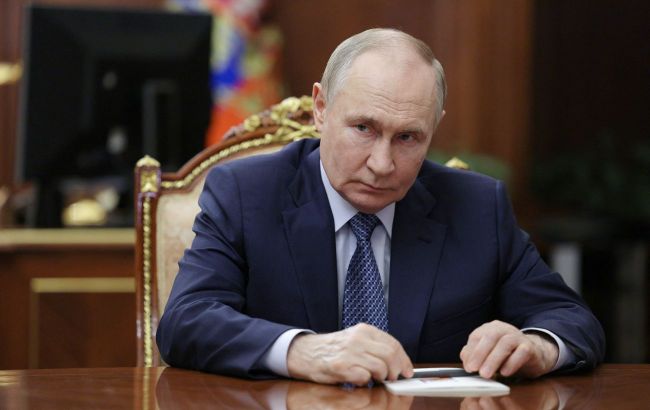 Photo: Vladimir Putin (Getty Images)
Russian dictator Vladimir Putin and several senior military commanders have significantly exaggerated claims that Russian forces captured the city of Kostiantynivka in Ukraine's Donetsk region. In reality, those claims are not supported by available evidence, according to the Washington-based Institute for the Study of War.
What happened
On Friday, July 3, Putin received briefings from Russian military commanders on the alleged capture of Kostiantynivka. They claimed assault units from separate motorized rifle battalions had seized specific locations in the city, including industrial facilities, churches, and residential neighborhoods.
"The Russian military command dedicated a significant portion of the meeting to these sub-tactical reports, likely to portray Russian forces as able to advance under conditions of urban warfare and to bask in the informational victory of the claimed seizure of Kostiantynivka.," ISW analysts said.
However, the analysts noted that these claims do not match the pattern of previous Russian advances. ISW typically identifies geolocated footage showing Ukrainian strikes on newly occupied Russian positions, but in this case, it found no such evidence anywhere in Kostiantynivka.
Why ISW says the videos are misleading
According to ISW, Russian sources, including the Russian Defense Ministry, have recently published numerous videos showing small groups of soldiers displaying Russian flags in and around Kostiantynivka to support official claims of territorial gains.
The analysts said those videos do not prove Russian control of the city, as they are often cut short and fail to show the troops' actual positions or what happened afterward.
ISW also found no footage showing Russian forces using armored vehicles, mortars, or tube artillery inside the city, which would normally indicate a higher level of operational control.
Why the Russian narrative falls apart
Ukrainian President Volodymyr Zelenskyy and Ukraine's General Staff have categorically rejected Russia's claims that Kostiantynivka has fallen.
According to Ukrainian military sources, between 100 and 250 Russian troops were present in the city as of mid-June.
As of June 23, Ukrainian forces still outnumbered Russian troops in Kostiantynivka, a situation that matched the pattern of strikes inside the city and contradicted Moscow's claims.
ISW also noted that several Russian military commanders and pro-war military bloggers continued to acknowledge on July 3 and 4 that Ukrainian forces still held positions in the city, further undermining the Kremlin's narrative.
Why the Kremlin is promoting the claim
According to ISW, Putin and other Russian officials are using the alleged capture of Kostiantynivka to reinforce claims that the rest of the Donetsk region will soon fall under Russian control.
The analysts said Russian forces are increasingly infiltrating the city and could eventually capture it, but such advances are unlikely to produce a rapid operational breakthrough across the Donetsk region.
ISW added that Russia's spring-summer 2026 offensive has so far failed to achieve operationally significant results and that the battle for Kostiantynivka will likely exhaust Russia's offensive potential, even if the city is eventually captured.
What else is known
After rejecting Russia's claims, President Volodymyr Zelenskyy challenged Putin to hold a bilateral meeting in Kostiantynivka, saying that if the city were truly under Russian control, the Kremlin leader should have no trouble traveling there.
Kremlin spokesman Dmitry Peskov dismissed the proposal and instead repeated that Zelenskyy could come to Moscow.
Later on July 4, Zelenskyy and US President Donald Trump held a phone call, followed by a separate conversation between Putin and Trump. During that call, Putin reportedly claimed that Russian forces were advancing along all sections of the front and spoke about what he described as the "realities" on the battlefield.