Putin fears drone assassination, coup as security tensions rise inside Kremlin

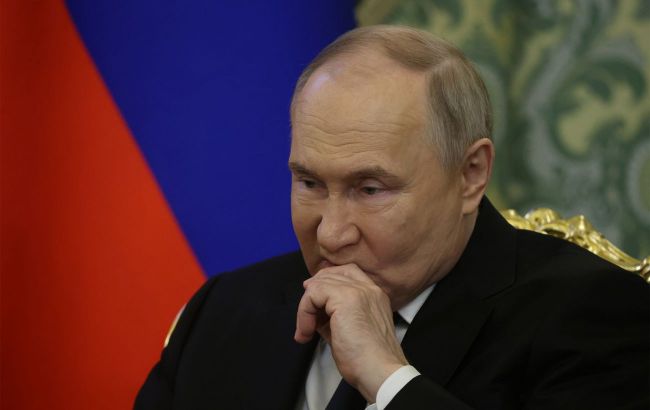 Russian President Vladimir Putin (photo: Getty Images)
Russian President Vladimir Putin fears assassination and a possible coup, while tensions are rising within Russian security forces, reports Important Stories.
As the publication writes, they obtained an intelligence report from one of the European Union countries regarding the situation in the Kremlin. The document was provided by a source close to the special services.
It is noted that since the beginning of March 2026, the Kremlin has been concerned about leaks of sensitive information, as well as the risk of a conspiracy or an attempted coup. In particular, Vladimir Putin fears a possible assassination attempt using drones, including from representatives of the Russian elite.
The growing fear has led to a significant strengthening of security measures around the Russian president.
Putin's fears
Thus, the Federal Protective Service, which is responsible for Vladimir Putin's life, has resorted to:
-
Introducing two levels of screening for visitors to the Russian presidential administration, including full inspections by Federal Protective Service personnel;
-
Significantly reducing the list of places that Putin regularly visits: for example, neither he nor his family appear anymore at previously favored residences in the Moscow region and Valdai;
-
Increasing the amount of time Putin spends in modernized bunkers, in particular in the Krasnodar region. He had been hiding in them since the beginning of the full-scale war in Ukraine, and now does not leave them for weeks while Russian propagandists broadcast pre-recorded materials;
-
Refusing to organize Putin's trips to military infrastructure: if last year he frequently visited such facilities, this year he has not appeared there at all;
-
Periodically shutting down communication networks in certain areas of Moscow;
-
Conducting large-scale raids by Federal Protective Service personnel using canine units, with service members also stationed along the Moscow River to respond to possible drone attacks.
In addition, the Federal Protective Service now controls and approves any informational or media publications involving the president, based on a secret presidential decree.
Employees who work near Putin are now prohibited from using mobile phones and are required to use devices without internet access.
These employees are also banned from using public transport and must move exclusively using Federal Protective Service transport. Surveillance systems have been installed in the homes of cooks, photographers, and guards.
Shoigu under suspicion
The main suspect in a possible preparation of a state coup has become Sergei Shoigu, former minister of defense and, since May 2024, secretary of the Russian Security Council, who retains significant influence within the military command.
European intelligence notes that the arrest of Shoigu's former first deputy, Ruslan Tsalikov, on March 5, 2026, is seen as a violation of informal security guarantees for elites, which weakens Shoigu's position and increases the likelihood that he himself may become a target of criminal prosecution.
Rising tensions among security structures
The issue of the physical security of leaders (officers) of the Russian armed forces has caused growing tensions among representatives of Russian security structures.
After the killing of Lieutenant General Fanil Sarvarov in Moscow on December 22, 2025, Chief of the General Staff Valery Gerasimov proposed to Vladimir Putin to convene a meeting of the permanent members of the Security Council to discuss the situation.
However, Putin preferred to hold a narrower meeting, which took place on December 25, 2025, the day after a new attack on Russian security personnel at the same location where Sarvarov was killed.
According to European intelligence, during this meeting, representatives of the security structures shifted responsibility onto each other for the shortcomings of the security system that became evident in light of attacks by Ukrainian services.
Gerasimov emphasized that these attacks are causing fear and disorganization within the ranks of the Russian armed forces and sharply reproached his colleagues from the special services for their inability to foresee them.
The Chief of the General Staff also complained about a lack of personnel resources for the physical protection of officers in the rear and drew Putin's attention to this issue.
Director of the Federal Security Service Alexander Bortnikov, for his part, defended himself, stressing the impossibility of systematically preventing such attacks.
He reproached the Russian minister of defense for the absence within his department of a special unit responsible for the physical protection of senior leadership, following the example of other security structures.
Director of the National Guard Viktor Zolotov, in turn, reminded that the resources at his disposal cannot be allocated to protect officers of the Ministry of Defense.
He also addressed recommendations to Gerasimov regarding operational security for defense ministry officers, which provoked anger from the Chief of the General Staff.
At the end of this tense meeting, Vladimir Putin called on the participants to remain calm and proposed changing the format of the discussion. He instructed the participants to submit their proposals for resolving the discussed issues within a week.
Strengthening of security measures
After the meeting, Vladimir Putin met with the Director of the Federal Protective Service, Dmitry Kochnev, whose primary task is to ensure the physical security of the country's top leadership.
It was decided to change the internal regulations of the Federal Protective Service, expanding the list of individuals under enhanced protection by this agency.
Previously, such protection applied only to Valery Gerasimov. Now, ten high-ranking generals have been added to the list of those under increased protection, including three deputy chiefs of the General Staff.
European Union intelligence believes that Putin's decision, made at the request of the General Staff, demonstrates the political weight of Gerasimov, who managed to succeed in this "arbitration," while other security structures have so far failed to secure an expansion of the Federal Protective Service's mandate in their favor.
As noted in the publication, some data from the report are confirmed by independent sources. In particular, it is reported that large-scale internet shutdowns in Moscow are carried out by the Federal Protective Service, not the Federal Security Service, as previously assumed.
Several sources also confirm that Putin's fear of a conspiracy or a coup has intensified. This is indicated both by unprecedented security measures and indirect signs.
For example, an active Federal Security Service officer told Important Stories that it has become much more difficult for his unit to obtain permission for wiretapping in non-political criminal cases, because "all equipment has been redirected to monitoring the government and other state bodies."
"The extraordinary degree of Putin's fear of an assassination attempt or a conspiracy is also indirectly evidenced by the fact that this year not a single State Duma deputy received an invitation to the Victory Day parade on Red Square," the publication states.