Pentagon seeks affordable interceptor for ballistic and hypersonic threats

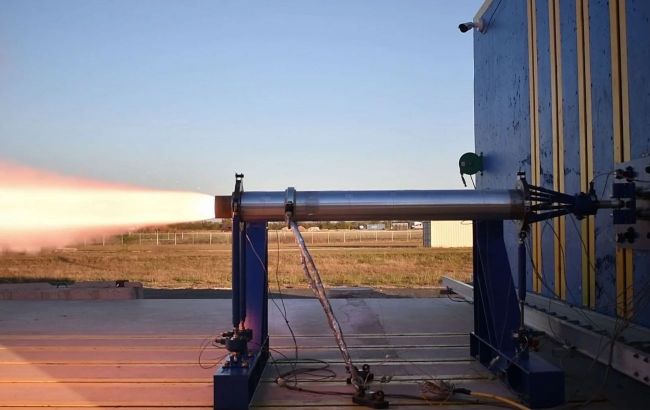 Photo: Engine test of the interceptor (X-Bow Systems)
The US Missile Defense Agency (MDA) has awarded a contract to X-Bow Systems to develop a Low-Cost Interceptor (LCI), according to X-Bow Systems.
In-house engine production as competitive advantage
What sets X-Bow's proposal apart is that the company independently develops both the interceptor itself and its solid-fuel engine, without relying on external propulsion system suppliers.
The LCI is intended to use X-Bow's in-house engine, and the company has already conducted static tests of a scaled-down demonstration version of this engine as part of the MDA program. This industrial approach combines engine design, propellant production, and missile integration within a single organization.
This model also addresses a problem that is becoming increasingly acute for the US defense-industrial complex: limited production capacity for solid-propellant rocket engines.
X-Bow's production model is based on its proprietary Advanced Manufacturing of Solid Propellant (AMSP) process and the Rocket Factory in a Box concept, which provides for stationary or mobile facilities for the production of solid-propellant engines.
According to the company, the AMSP process is certified by the US Air Force Research Laboratory.
The LCI program should be distinguished from the Buckler interceptor, which X-Bow unveiled in July 2026. The Buckler, a standalone anti-aircraft weapon designed primarily to counter Group 3 drones, has already undergone flight tests, reaches supersonic speeds, and, according to the company, will cost less than $100,000 per unit.
The LCI, on the other hand, is designed to counter a more complex range of threats, including ballistic and hypersonic missiles, which place significantly stricter demands on speed, guidance, target recognition, and intercept geometry.
Why does Pentagon need cheaper interceptor?
The contract does not yet call for the production of a serial combat missile—its goal is to test a different approach to the economics of interceptors. The MDA Low-Cost Interceptor program focuses on modular missiles costing up to $750,000 per unit, which rely as much as possible on existing technologies where they meet the requirements and are developed on an accelerated schedule.
According to the program documentation, the interceptor's architecture encompasses the core functions of a modern interceptor missile: a propulsion system, a flight control system, communication channels, fire control interfaces, terminal sensors, and a target-engaging warhead. One of the key requirements is compatibility with existing missile defense systems.
A less expensive interceptor would address more than just the unit cost. It would give commanders greater flexibility in allocating missiles against attacks involving multiple trajectories, decoys, or simultaneous strikes.
Within a layered defense system, the LCI class could complement, rather than replace, more expensive interceptors, reserving the latter for targets requiring greater range, speed, or detection capabilities.
The main benefit here is the depth of the ammunition supply: larger stockpiles create additional opportunities for interception, support salvo fire where doctrine requires it, and reduce the risk that an air defense system will be left with operational radars and launchers but almost no missiles.
The Pentagon's interest in such systems reflects a broader problem that is becoming increasingly apparent in Washington. Large-scale military aid to Ukraine since 2022, as well as prolonged operations and US missile intercepts in the Middle East, have depleted many American arsenals, particularly in the areas of air and missile defense.
The shortage of interceptor missiles is currently one of the key challenges facing the US defense-industrial complex. It was previously reported that US air defense systems will receive more missiles thanks to new Pentagon contracts, as the United States has expended nearly 80% of its primary interceptor missiles in the war with Iran.
At the same time, the Pentagon is increasing spending on other categories of precision-guided weapons—in particular, it plans to spend over $20 billion on the production of Tomahawk cruise missiles as part of the Arsenal of Freedom initiative.