Peace Board explained: Trump’s goals and Ukraine’s perspective


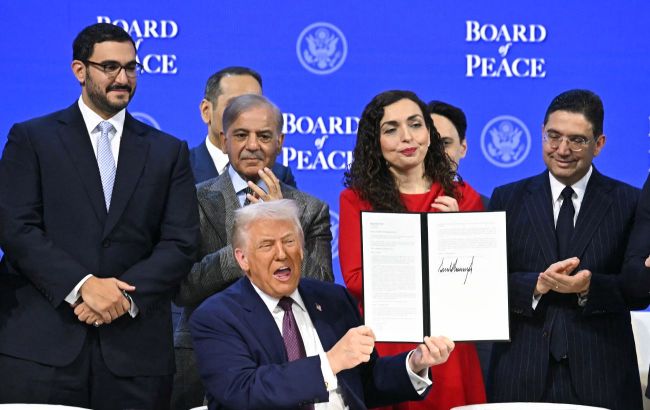 Donald Trump and other leaders during the establishment of the Peace Board (photo: Getty Images)
So far, only about two dozen of the less influential countries have joined Donald Trump’s much-publicized Peace Board.
RBC-Ukraine explains how powerful this organization could become, who else might join it, and whether it will be involved in the war in Ukraine.
Key points:
-
The Board was created as a business tool, with no intention of replacing the UN.
-
Washington is considering this model for other conflicts around the world, including in Ukraine.
-
Most EU countries, China, India, and Brazil did not join the Peace Board, limiting its potential.
-
Ukraine is skeptical about the Peace Board due to the possible membership of Russia and Belarus and its questionable effectiveness.
Together with representatives and leaders from Paraguay, Uzbekistan, Kosovo, and 16 other countries, Donald Trump ceremonially signed the charter of a new organization in Davos, placing himself at its head – the Peace Board.
"The Board of Peace is now an official international organization," White House spokeswoman Karoline Leavitt said after the ceremony.
However, the new structure has little in common with organizations like the UN. The differences are even reflected in the name. "Board" is mainly used in business, while "Council" is more common in political contexts.
The business-oriented approach is clearly visible in how the organization is intended to operate. The Peace Board was initially planned primarily to manage the conflict between Israel and Hamas in the Gaza Strip.
There, the new body is expected to oversee demilitarization and the phased reconstruction of the territory. It will also be responsible for disarming Hamas, deploying international stabilization forces, and supervising the work of a temporary civilian administration in Gaza.
Even at this early stage, US officials have begun talking about the possibility of a broader mandate for the Board. Washington’s logic is that if the model works in Gaza, it could be applied to other long-standing conflicts.
US Secretary of State Marco Rubio stated that the Board will focus on implementing the peace plan in Gaza. However, he added, it could "serve as an example of what is possible in other parts of the world" – including Ukraine and Venezuela.
At the same time, the new organization resembles the closed clubs that Trump’s circle has traditionally used for informal connections between business and government – and for promoting their political initiatives outside of conventional international institutions.
So, at least for now, it is not meant to replace or duplicate UN structures.
"Once this board is completely formed, we can do pretty much whatever we want to do, and we'll do it in conjunction with UN," Trump said at the ceremony. He added that the UN has great potential that has yet to be fully realized.
What the list of participants shows
On the eve of the ceremony, Trump sent invitations to 49 countries. However, many of them quickly declined to participate. Most European countries did so against the backdrop of Trump’s threats to impose trade tariffs over the situation with Greenland. Among EU members, only Hungary and Bulgaria joined the Peace Board.
Others, US Secretary of State Marco Rubio said, are still reviewing the proposal and have lengthy internal procedures. Belarus, Vietnam, and Canada had previously announced their agreement to join. In addition, Russia is still considering Trump’s invitation – which in itself could deter a number of other countries.
The initial lineup also does not include countries that are the most powerful in their regions – India, Brazil, or China. This could become a critical factor.
"Many countries look to China. And if it ultimately does not agree to participate – which is unlikely to happen before Trump’s meeting with Xi Jinping in April – this structure risks remaining nonfunctional," Oleksandr Leonov, executive director of the Center for Applied Political Studies Penta, told RBC-Ukraine.
Even if the lineup expands somewhat, it already sets the "ceiling of possibilities" for the Peace Board, especially when it comes to Ukraine.
Ukraine’s position
President Zelenskyy had previously expressed reservations about Ukraine’s participation in the Peace Board, as Russia and Belarus were also invited.
"Russia is our enemy, Belarus is their ally. It’s hard to imagine how we could be together with Russia in any board," Zelenskyy said.
In the end, he did not attend the ceremony establishing the Board, even though he was in Davos at the time.
Beyond the possible membership of Russia and Belarus, there are other obstacles complicating Ukraine’s participation. The main one is the Board’s questionable effectiveness in the context of ending the Russia-Ukraine war.
"It seems this initiative will remain local. Without European countries and China, it will just be Donald Trump’s club, where the entry ticket costs a billion dollars. And once Trump leaves office, the Peace Board will most likely cease to exist," Leonov told RBC-Ukraine.
In the end, the US president once again demonstrated his ability to think big. However, his own chaos and unpredictability often prevent plans from being realized in practice – after which Trump quickly loses interest. Despite its grand start, the Peace Board project could face the same fate.
This might be of interest
– What was the Peace Board’s initial mission according to Washington’s plan?
The Board was primarily planned to manage the conflict in the Gaza Strip between Israel and Hamas. It is tasked with overseeing demilitarization, disarming Hamas, reconstructing the territory, and supervising the temporary civilian administration.
– Is there a possibility of applying the Peace Board model to resolve the conflict in Ukraine?
Yes. US Secretary of State Marco Rubio said that if the model proves successful in Gaza, it could serve as an example for other regions, including Ukraine and Venezuela.
– Why did Ukrainian President Volodymyr Zelenskyy not join the establishment of this organization?
The main reason was that Russia and Belarus were invited to the Board. Zelenskyy noted that it is difficult to imagine participating in a single structure alongside an aggressor country and its ally. There are also doubts about the Board’s effectiveness in ending the war.
– Which European Union countries agreed to become members of the Peace Board at its founding stage?
Among EU members, only Hungary and Bulgaria joined the Board. Most other European countries declined amid Trump’s threats of trade tariffs over the Greenland situation.
Sources: materials from Politico, CNN, Times of Israel, Reuters, and comments from Oleksandr Leonov.