Musk wants to launch 1 million AI satellites — Forbes fears catastrophe in orbit

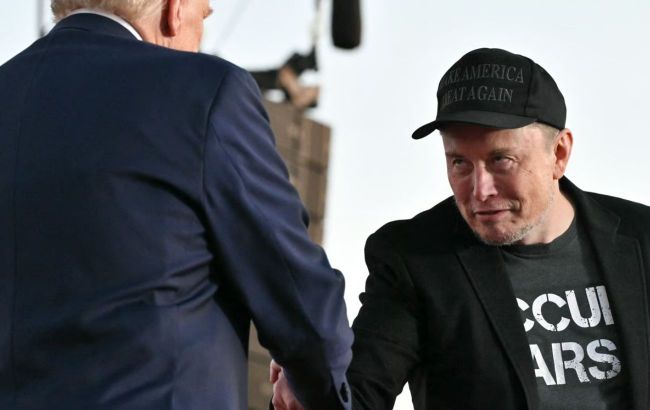 US President Donald Trump and Elon Musk (Photo: Getty Images)
Elon Musk plans to launch one million satellites into orbit by 2028 to power artificial intelligence. However, leading scientists are warning of a possible financial collapse of SpaceX due to the astronomical cost of the project, reports Forbes.
The founder of SpaceX sees the future in orbital data processing centers. His goal is to provide AI to billions of people. However, implementing this idea is too expensive. The company has already launched about 10,000 Starlink satellites.
Each satellite costs $2 million. Scaling this system to one million units would require staggering spending. Experts estimate the budget at $2 trillion — equivalent to SpaceX’s entire projected valuation after a public listing.
Robert Zubrin, a well-known rocket engineer, is skeptical. He has known Musk for over 25 years and warns that this move could interrupt the businessman's successful streak.
"Launching a million satellite orbital data center constellation is fantasy," the scientist says.
Why space loses to Earth
The technical challenges are no less staggering than the financial ones. Musk promises to launch the giant Starship every hour, which would mean 8,700 flights per year. Currently, SpaceX carries out an average of three launches per week.
The project's economics also raise questions:
- Energy in space costs about $100,000 per kilowatt.
- Ground-based solar panels provide energy at $3,000 per kilowatt.
- Gas generators lower the price to $1,000.
Ground-based data centers remain far more cost-effective. Musk thinks otherwise.
"My estimate is that within 2 to 3 years, the lowest cost way to generate AI compute will be in space," he said in a statement on the company's website.
Google's predictions and the future of Starship
Scientists from Google's Project Suncatcher are also exploring space-based computing. Their forecasts are less optimistic than Musk's timelines. Space stations may only become competitive by the mid-2030s.
For this to happen, SpaceX must achieve incredible performance. Launch costs would need to drop to $200 per kilogram, which is only possible with full reusability of Starship. The latest tests of the ship have had mixed success: the rocket's first stage fell into the ocean due to engine failure.
Brian Hurley from the New Space Economy agrees with his colleagues. He believes that deploying such networks is only realistic a decade from now. One must account for maintenance costs, insurance, and risks. Space is not yet ready to host such a volume of equipment.
IPO and gold rush
Why would Musk pursue such a risky plan right now? The answer may lie in a future IPO (going public). Musk wants to make the stock market listing of SpaceX and xAI as high-profile as possible, and he is using the hype around artificial intelligence to do so.
Zubrin is convinced that Musk is playing on investors' emotions.
"He’s calculating that people are looking at this and saying, 'Well I don’t know if this is really going to work but you know no one's ever lost money betting on Elon Musk,'" the expert sums up.
Currently, SpaceX remains the world leader in the number of launches, ahead of even NASA. However, the ambition of a million satellites jeopardizes even the trip to the Moon. Due to delays with Starship, NASA has already begun looking for alternative contractors for astronaut landings.
What else is interesting to know about space
One of Musk's main rivals in the space race to the Moon, billionaire Jeff Bezos, has had a failed launch of the New Glenn rocket, which his company Blue Origin developed specifically for NASA's lunar program. Within seconds of liftoff, the system was engulfed in flames.
Meanwhile, NASA is beginning construction of a large-scale base at the Moon's south pole. The agency has already ordered the first landers, rovers, and drones to prepare for astronaut landings.
Ukraine may join the historic project of building a base on the Moon. NASA is interested in the capabilities and engines from the Yuzhnoye Design Bureau, but Ukraine's participation comes with its own nuances.