Blue Origin rocket explodes during launch: NASA lunar program in danger

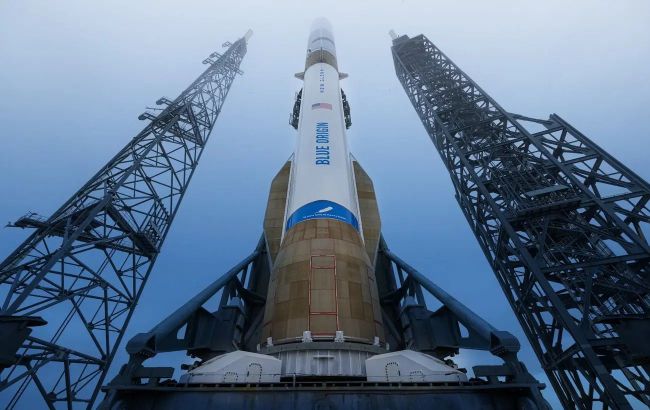 Bezos suffered a fiasco while Musk prepares his Starship (photo: Blue Origin)
A major accident occurred at the Kennedy Space Center in Florida. The heavy launch vehicle New Glenn, developed by Blue Origin specifically for NASA’s lunar program, exploded just seconds after its engines ignited. A massive fireball destroyed the launch pad, according to The Guardian.
What happened at Cape Canaveral?
The incident took place at around 9:00 p.m. local time during a so-called “hot fire” test, when the rocket’s engines are ignited while the vehicle remains secured to the ground.
Within seconds of ignition, the system was engulfed in flames. A powerful blast wave shook homes in nearby Cape Canaveral and Cocoa Beach, and the glow from the fire was reportedly visible as far away as South Carolina.
Blue Origin founder Jeff Bezos quickly responded to the incident, noting that all employees are alive, well, and safe. At the same time, the billionaire described the event as a very difficult day, but assured that the company will rebuild the launch site and return to flight operations.
All personnel are accounted for and safe. It’s too early to know the root cause but we’re already working to find it. Very rough day, but we’ll rebuild whatever needs rebuilding and get back to flying. It’s worth it.
— Jeff Bezos (@JeffBezos) May 29, 2026
Why is this explosion a major setback for NASA?
The New Glenn accident is a major challenge to NASA’s schedule. Just two days before the disaster, Blue Origin secured a major contract for launching the first of three missions intended to begin construction of a future lunar base valued at $20 billion.
In addition, Bezos’ company is in intense competition with Elon Musk’s SpaceX to develop lunar landing modules for astronaut missions to the Moon as part of the upcoming Artemis III (2027) and Artemis IV (2028) programs. These timelines may now need to be significantly revised.
NASA Administrator Jared Isaacman has already stated that the agency will conduct a full assessment of the situation. He emphasized that spaceflight does not forgive mistakes and that building heavy-lift rockets is an extremely complex process.
NASA is aware of the anomaly that occurred tonight at Launch Complex 36 involving Blue Origin’s New Glenn rocket at Cape Canaveral Space Force Station. ⁰⁰Spaceflight is unforgiving, and developing new heavy-lift launch capability is extraordinarily difficult. We will work with…
— NASA Administrator Jared Isaacman (@NASAAdmin) May 29, 2026
While Blue Origin officially calls the explosion an anomaly, experts expect another forced suspension of experimental space flights by the U.S. Federal Aviation Administration (FAA).