'Kill zone up to 20 km': Ukrainian military explains battlefield reality in Zaporizhzhia region

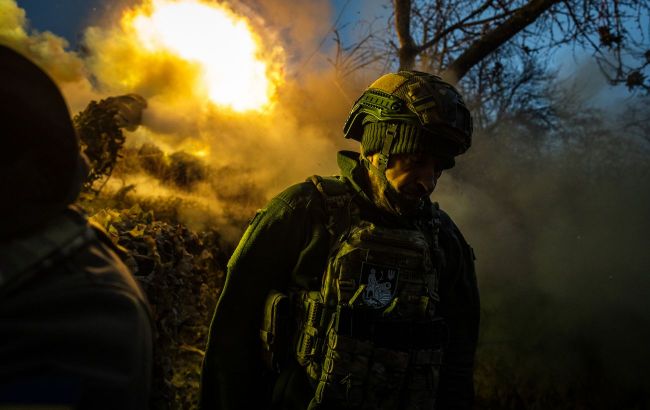 Kill zone in Zaporizhzhia region reaches 20 km from contact line (photo: Getty Images)
The situation in southern Ukraine is difficult, but without sharp changes in the situation. One of the biggest features of the war in the steppe is a larger kill zone than in other directions of the front, Southern Defense Forces spokesperson Vladyslav Voloshyn said on the national telethon.
"Most clashes recently have traditionally been on the Huliaipole direction. Situation is also quite tense on two other Zaporizhzhia directions — Orikhiv and Oleksandrivka — and opposing forces do not abandon attempts to carry out attacks and kamikaze drone strikes on Prydniprovske or Kherson directions," Voloshyn said.
According to him, 50 combat clashes were recorded in the south over the past day, 36 of them in Huliaipole.
Russian forces tried to assault Ukrainian positions in Huliaipole, south and north of this settlement.
In addition, Russian forces attempted to assault Ukrainian positions near Bilohiria, as well as near settlements north of Huliaipole — Dobropillia and Pryluky, where they tried to storm Ukrainian positions and made attempts to infiltrate deeper into Ukrainian defense.
According to a spokesperson, in recent days, opposing forces carried out fewer kamikaze drone attacks. However number of air strikes is constantly increasing.
"Over the past day, more than 20 air strikes were recorded using 70 guided aerial bombs," Voloshyn reported.
He noted that sides are increasingly using unmanned aerial vehicles and ground robotic systems on the battlefield every day. In particular, opposing forces use up to 2000 first-person-view drones, 150–200 loitering munitions, and 200–250 drones operating as reconnaissance.
In addition, opposing forces have recently been widely using ground robotic systems that are used for logistics and the evacuation of wounded from the battlefield.
Regarding the specific features of combat operations in the steppe zone, Voloshyn said the line of contact here stretches over 100 kilometers. Opposing forces cannot bypass Ukrainian positions unnoticed, so they resort to other means. For example, they make greater use of electronic warfare systems.
"One of the biggest features of war in the steppe is that the kill zone here is much wider than in areas with rough terrain. Today, this so-called kill zone, that is, the strip from the line of contact where everything moving is targeted, one could say, already reaches approximately 15, or even up to 20 kilometers from the line of contact," a spokesperson explained.
Situation on the front
Earlier, the head of the Center for Countering Disinformation of the National Security and Defense Council of Ukraine, Andrii Kovalenko, reported that in February, Russian forces would try to increase pressure on the front and attempt to fight actively at least until spring.
In particular, Commander in Chief of the Armed Forces of Ukraine Oleksandr Syrskyi reported that Russian forces are advancing along the entire front line with varying intensity. The active zone reaches 1200 kilometers, and the kill zone is 15–20 kilometers deep.
In addition, according to Deputy Head of Office of the President of Ukraine Pavlo Palisa, Russian forces plan to capture the entire Donetsk region by the end of March. Plans to seize territories also concern other regions.
At the same time, the Ukrainian military during the February offensive on southern direction of the front liberated several settlements.
On February 20, President of Ukraine Volodymyr Zelenskyy reported that Ukrainian troops had liberated about 300 square kilometers of territory in the south.
In addition, on February 22, information appeared about active actions of the Air Assault Forces of the Armed Forces of Ukraine on the Oleksandrivka direction. Their key goal is to hinder the Russian plans for further advance within the Dnipropetrovsk and Zaporizhzhia regions.
Syrskyi also reported that the Defense Forces of Ukraine, during the offensive in the south, liberated eight settlements and about 400 square kilometers of territory.