Is Greenland on the table? Trump talks deal as Rutte emerges behind the scenes

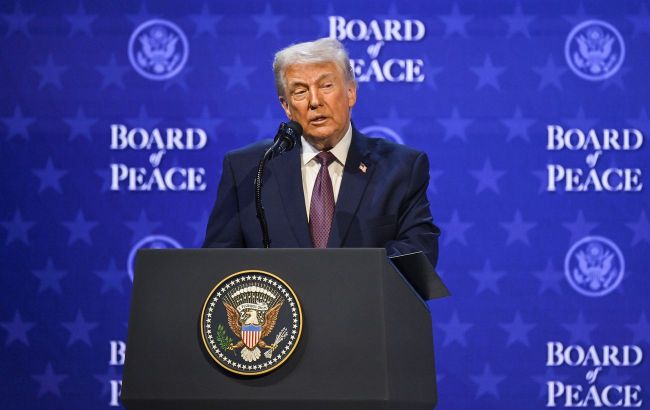 Photo: US President Donald Trump (Getty Images)
US President Donald Trump has unexpectedly changed his mind about taking Greenland by force.
RBC-Ukraine explains how and on what terms he reached agreements with Europeans, and whether the subject of Greenland’s annexation can be considered closed.
How a compromise was found
On Wednesday, January 21, after weeks of tension and threats, Donald Trump unexpectedly said that a compromise agreement on Greenland could be reached between the United States and its NATO allies.
After a meeting with NATO Secretary General Mark Rutte on the sidelines of the Davos forum, the US president said he was ready to outline “frameworks” for a potential agreement.
Such a sharp shift in his rhetoric came as a major surprise. In his confrontational speech just hours before meeting Rutte, Trump said the United States “needs” Greenland. But, most importantly, Americans would not use force to seize it, Trump promised. He later also confirmed that he would not impose tariffs on EU countries that he had threatened to introduce starting February 1.
Reuters reports that the president’s position may have been influenced by his advisers. White House sources told the agency that Thomas Dans, appointed by Trump as head of the US Arctic Research Commission, together with Vice President JD Vance and Secretary of State Marco Rubio, pushed for a compromise solution on Greenland. US officials were concerned about the panic Trump’s rhetoric had caused among European allies.
What we know about the agreement
Despite the loud statements, the terms of the future agreement remain extremely vague. Mark Rutte said he had a “very good" discussion with Trump about how NATO allies could work together to ensure security in the Arctic, including not only Greenland but also the seven NATO countries that have territory in the Arctic. The main priority, he said, should be to exclude the possibility of Russian and Chinese influence in the region.
According to Trump, the framework agreement ensures US access to Greenland’s mineral resources and allows for the future deployment on the island the Golden Dome missile defense systems.
But the words of the US president partially diverge from those of Rutte. The Secretary General said that the extraction of critically important minerals was not discussed. According to Rutte, specific terms were to be discussed between the United States, Denmark, and Greenland.
Trump avoided a direct question about whether Greenland would be under US control. “It's the ultimate long-term deal...It's a deal that's forever,” he said.
Rutte, in turn, confirmed that the issue of Greenland’s ownership was not raised at the meeting.
The New York Times, citing anonymous NATO sources, claims that one condition of the agreement could be the transfer of some Greenland territories under US jurisdiction, where the United States could deploy military bases. It could resemble the model of the US base at Guantanamo in Cuba, or British bases in Cyprus.
The differences in Rutte’s and Trump’s statements suggest that the potential agreement is still at a very early stage.
How Europe is reacting
In the EU, Trump’s change in rhetoric was met with caution. “After the disputes of the past few days, we should wait and see what substantive agreements will be reached between Mr. Rutte and Mr. Trump,” said German Vice Chancellor Lars Klingbeil. According to him, it is still too early to talk about the end of the dispute between the EU and the United States.
Other European officials share his restraint. “I would be skeptical about calling this fantastic news. We cannot live our lives or run our countries based on social media posts,” a European official involved in the discussions these days told Politico.
Denmark, which is most directly affected by the issue, also showed no excessive enthusiasm. “For us, the most important thing is that we put an end to this with respect for the integrity and sovereignty of the kingdom (of Denmark) and the right of the Greenlandic people to self-determination,” Danish Foreign Minister Lars Løkke Rasmussen said.
The Danish government publicly outlined its red lines. Prime Minister Mette Frederiksen immediately categorically rejected any form of losing sovereignty over Greenland’s territories, including military bases. She also noted that she is in constant contact with Mark Rutte, but that he does not have a mandate to speak on behalf of Denmark or Greenland.
Despite a number of cautiously optimistic statements, it is still far too early to consider the case of American encroachments on Greenland resolved, or even close to resolution.
First, the various "great deals” proposed by Trump have often turned out to be completely unacceptable to the other side. Second, the US president is known for his changeable nature. And at present, there are no guarantees that his position will not shift to a radically opposite one within a few days.
Nevertheless, the unity and determination of European countries in defending their common interests appear to have yielded some results. Time will show how the Greenland saga ends, but today, quoting Danish officials, “the day ends better than it began.”
Sources: statements from European and American officials, as well as articles by Politico, The New York Times, and Reuters.