Iran’s Kheibar Shekan missile explained: What makes it so dangerous

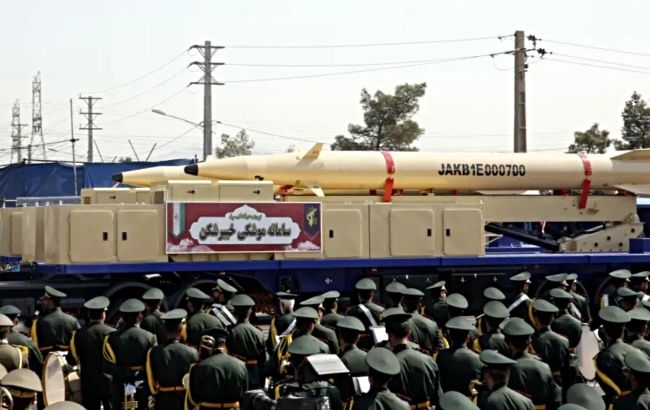 Iran's Kheibar Shekan missile (Photo: Getty Images)
Iran's ballistic missile, the Kheibar Shekan, has become one of the most prominent developments in Tehran's missile arsenal. It has attracted the attention of military experts due to its combination of mobility, a solid-fuel engine, and the ability to change trajectory during the final phase of flight, according to Newsweek.
The Kheibar Shekan is an Iranian medium-range ballistic missile, which was unveiled by the Islamic Revolutionary Guard Corps (IRGC) in 2022. It belongs to the Fateh family of solid-fuel missiles and has become one of the most advanced developments of Iran's missile program.
According to Iranian claims, the missile has a range of approximately 1,450 km. This allows it to potentially strike targets across a large part of the Middle East, including territories far beyond the country's immediate borders.
Unlike older Iranian liquid-fuel missiles, the Kheibar Shekan uses a solid-fuel propulsion system. This design has several advantages: missiles can be stored for longer periods in a ready state, require less time for launch preparation, and can quickly reposition after use.
Why mobility became the missile's key feature
One of the key characteristics of the Kheibar Shekan is its mobility. According to open sources, the missile can be launched from mobile launchers, making it harder to detect and destroy the complexes before launch.
For modern missile systems, rapid deployment has become one of the important factors. Even a precision-guided missile has limited effectiveness if its launchers are easy to detect and destroy.
Analysts note that the development of mobile missile systems is part of Iran's broader strategy — to create a system that allows it to maintain the ability to strike even in the face of enemy countermeasures.
Maneuverable warhead and the difficulty of interception
Another feature of the Kheibar Shekan is the claimed ability of its warhead to change trajectory during the terminal phase of flight. Such technologies can complicate the operation of missile defense systems, which are designed for predictable ballistic trajectories.
According to Iranian sources, the missile is equipped with a warhead weighing approximately 550 kg. At the same time, it is difficult to independently verify all the stated characteristics, as a significant portion of information about Iranian missile systems comes from official Tehran statements.
Military experts note that even modern air and missile defense systems do not guarantee absolute protection against ballistic missiles. That is why states pay significant attention to developing early warning systems and multi-layered defense.
Why the cost of the missile became a factor in itself
In addition to technical characteristics, military analysts are also interested in the cost ratio between offensive and defensive means. Iran's Kheibar Shekan missiles create a problem not only because of their range or maneuverability, but also because their estimated price is significantly lower than the cost of many Western interceptor missiles.
The exact cost of the Kheibar Shekan is not disclosed, but experts estimate Iranian ballistic missiles of this class as significantly cheaper than modern American interception systems. For comparison, one US Navy SM-6 interceptor missile can cost about $4–5 million, and a PAC-3 MSE missile for the Patriot system costs approximately $4–6 million per unit.
In contrast, the cost of an Iranian missile, according to analysts' estimates, could be an order of magnitude lower. This creates the problem of so-called "cost depletion of air defense: even successful interception of every target may require the expenditure of significantly more expensive munitions.
A similar situation has already been observed during massive attacks using cheaper drones. The defending side is often forced to use expensive air defense missiles to destroy relatively inexpensive targets. In the event of large-scale use of missiles together with drones, this can create additional strain on interceptor stocks and defense system logistics.
That is why modern armies are developing not only expensive missile systems but also cheaper countermeasures — in particular, short-range systems, electronic warfare means, and laser technologies.
Context of the news
Despite nearly two weeks of strikes on Iran, Washington has decided to suspend its attacks. In this way, President Donald Trump is giving Tehran room for diplomacy.
Earlier, Trump warned that Washington would hold Iran responsible for any new attacks by Yemen's Houthis on commercial vessels. According to him, Tehran, as well as the militants themselves, will face a harsh military response in the event of further escalation.