Iran and US exchange strikes in overnight escalation: Details

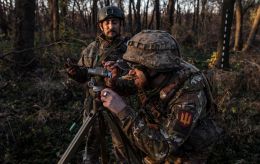
 The US reported that the attacks had ceased by morning (Photo: Getty Images)
On the night of June 10, the US and Iran exchanged mutual strikes. However, the initiative came from Washington after the Iranians shot down a US Apache helicopter on Monday, according to CNN, ABC News, and the X page of US Central Command (CENTCOM).
What preceded this
On Tuesday, June 9, US President Donald Trump stated that a deal with Iran could be reached in the coming days.
However, later that same day, he wrote on social media that an AH-64 Apache military helicopter had crashed in the area of the Strait of Hormuz on Monday. According to him, the helicopter was shot down by Iran, so he promised to respond to the incident.
How the mutual attack began
Exactly on the night of June 10 (Kyiv time), Donald Trump gave a short comment to ABC News, saying that the US response to the downed helicopter had to be powerful.
"I believe in responding in a strong manner. I always have throughout my life. And we have a deal that was very good, and probably will [still be]. This is a response to what they did they did with our helicopter last night, and I believe the response should be very strong, very powerful, and that's what this one is," Trump said.
Immediately after this, CENTCOM announced an attack on Iran, and Iranian media reported sounds of explosions in Bandar Abbas, Sirik, and Qeshm.
After that, the IRGC claimed that Iran was launching missiles and drones at US targets in the Middle East. A little later, Iranian Foreign Minister Abbas Araghchi said that no US attack would remain without response, but at the time, it was still unclear whether Iran had actually attacked US facilities.
"Our powerful armed forces will leave no attack or threat unanswered. Leave our region if you want to be safe. History of the Persian Gulf has many chapters on dire fates of intruding outsiders," Araghchi wrote.
At approximately 03:00, the media began reporting a second wave of US strikes on Iran.
What results did the parties report
By 04:00, CENTCOM announced that the US had completed its attack on Iran and emphasized that these were self‑defense strikes in response to the downing of the US Apache helicopter.
The post reads that United States Central Command forces had struck Iranian air defense systems, ground control points, and radar surveillance stations near the Strait of Hormuz using precision munitions launched from U.S. Air Force and Navy fighter jets.
They added that the operation was proportionate to recent attacks on US forces and international commercial vessels passing through regional waters.
Meanwhile, the IRGC claimed to have struck the US Fifth Fleet in Bahrain and a US military base in Jordan where US troops were stationed. However, there was no alert signal in Jordan, as CNN reported — there was none.
Also, the Tasnim news agency reported, according to an IRGC statement, that US strikes allegedly damaged a communications tower in Sirik and destroyed two water reservoirs in the Bamani area.
US‑Iran negotiations
US Vice President JD Vance said in an interview with CBS that Washington is very close to a deal that would solve Iran's nuclear problem. He believes the deal could be concluded either next week or in a few months, but emphasized that it would happen before the US midterm elections.
According to Israeli Prime Minister Benjamin Netanyahu, his country may find itself in a situation where it has to confront Iran alone — that is, without US support.