Hungary's Magyar party heading for historic parliamentary majority

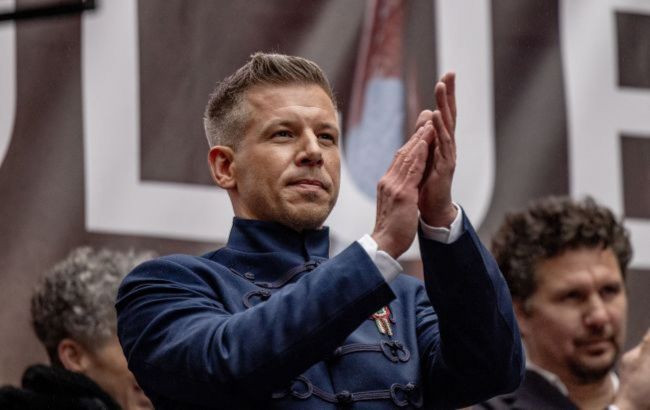 Hungary's expected prime minister Peter Magyar (photo: Getty Images)
Peter Magyar's Tisza party has strengthened its position in Hungary's parliament following the final vote count. This gives the new government full freedom to carry out constitutional changes, Bloomberg reports.
Vote results, seat distribution
According to the outlet, updated data shows that the Tisza party will hold 141 seats in the 199-member National Assembly. This is more than previously forecast (138 seats) and represents a record under the country's current electoral system.
Meanwhile, former Prime Minister Viktor Orbán's Fidesz will hold only 52 seats. The far-right Mi Hazank party secured six seats.
Peter Magyar, the expected future prime minister of Hungary, is set to be sworn in around May 9.
New government priorities
With a two-thirds majority, Peter Magyar gains the ability to amend the constitution and dismantle the system built under Viktor Orbán.
A key priority for the new cabinet will be unlocking European Union funding, as Hungary's economy is in urgent need of these resources.
Representatives of the European Commission have already arrived in Budapest to discuss a "roadmap" for this process.
Election disputes
Despite the decisive victory, Magyar has questioned the results in one district in the west of the country, where a Tisza candidate narrowly lost to a Fidesz representative.
The dispute stems from the appearance on the ballot of an independent clone candidate also named Peter Magyar. The Tisza leader called it a deliberate manipulation intended to mislead voters.
Magyar's victory
Inauguration of Hungary's new government is expected at the beginning of next month.
The media previously reported that Peter Magyar will officially become prime minister on May 9.
His victory marks the end of Viktor Orbán's 16-year rule, despite support from external allies.
At the same time, for Kyiv, the change of power in Budapest remains ambiguous. While Magyar promises a pro-European shift, his position on Ukraine still includes certain reservations that Western media describe as "bittersweet."