Germany prepares for possible Russian attack on NATO within three years

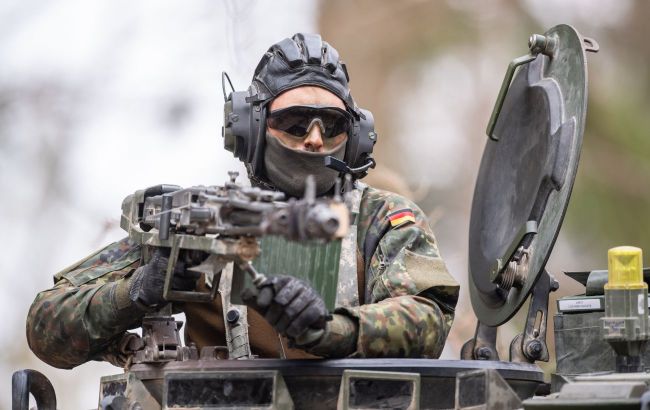 NATO could be at war with Russia in two to three years (illustrative photo: Getty Images)
In Germany, it is believed that two to three years remain before a possible Russian attack on NATO countries. In this scenario, the country would be at the epicenter of events as one of the Alliance's key members, according to an interview with Lieutenant General Gerald Funke, head of the German Armed Forces Support Command (Bundeswehr logistics and support command), given to The Times.
Funke believes that in two or three years, a scenario of a Russian attack on NATO countries can be expected. In this case, one of the main problems would be logistics, as tens of thousands of NATO soldiers would need to be transported to the front.
However, logistical routes would most likely be damaged by Russian missile and drone strikes, sabotage, or cyberattacks. In this scenario, Germany would be one of the Alliance’s key logistical hubs.
"It's important for us to maintain Germany as a logistics hub and manage the supply lines for as long as possible as smoothly as possible, meaning that if one route fails, we will have the option of using others instead," the general explained.
Too many wounded
Another problem is the huge number of wounded, which could reach thousands per day. The Bundeswehr has only five of its own hospitals with 1,800 beds, which would quickly become overwhelmed.
Therefore, a decision has been made to divide civilian hospitals into four sections, which are planned to be reserved in different situations to accommodate the wounded. Funke complained that in Afghanistan, he had a "high but manageable number of wounded," whereas now he has to plan for the possibility of receiving a thousand wounded per day.
"The closer you look at it, the more complex it becomes and the harder it is to imagine," he said.
Modern logistics and legal challenges
The German Armed Forces Support Command, established in 2025, is currently working on developing a requisition system for military needs involving trucks, railcars, food supplies, and manpower. The scale of the requisitions will be enormous, comparable to those planned if the Cold War had turned hot.
In particular, Funke initiated agreements with Germany's national rail operator Deutsche Bahn. Under these agreements, within three days of notification from the Bundeswehr, the company must provide trains for transporting military equipment.
However, Germany's legal system creates too many complications. Most of the relevant military measures can be implemented only if two-thirds of Bundestag members approve the declaration of a "state of tension" or a "state of national defense."
At the same time, more than a third of seats in the current parliament are held by radical leftists and pro-Russian far-right lawmakers. It is unlikely that allies of the Kremlin would allow the German army to function normally.
Germany's Ministry of Defense expressed concerns as early as the beginning of January that covert attacks on German infrastructure carried out by Russia could become a prelude to a much broader "hot conflict," during which the Kremlin would attempt, through "hybrid warfare," to prevent NATO forces from deploying.
Overall, the media paint a bleak outlook for NATO. Despite the threat of a global conflict, NATO countries are completely unprepared for it. Hybrid war is already underway, Russia is preparing to attack NATO in a few years, and the state of war preparedness in the West is catastrophic.