Europe unveils most powerful spectrograph to capture thousand galaxies at once

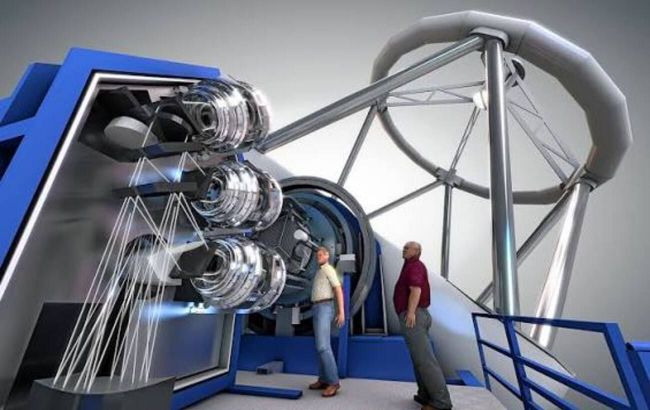 New MOONS spectrograph "listens" to a thousand galaxies simultaneously (screenshot: MOONS)
The European Southern Observatory, together with its partners, has launched the largest spectrograph in history, MOONS. The 10-ton instrument is capable of simultaneously analyzing light from a thousand cosmic objects, according to Futura.
How does MOONS work?
The name MOONS is an acronym for Multi-Object Optical and Near-infrared Spectrograph.
The 4.5-meter-high and 10-ton apparatus is mounted directly onto one of the 8-meter telescopes of the VLT (Very Large Telescope) complex in Chile.
The instrument's design is built for high observational performance:
- Approximately 1,000 thin optical fibers are connected to a special circular system.
- Each fiber is precisely targeted at an individual star or galaxy within the telescope's field of view.
- The collected light is simultaneously transmitted to powerful spectrographs at the rear of the instrument, allowing data from a thousand objects to be recorded in parallel.
Observations through cosmic dust
The main advantage of MOONS lies in its ability to operate in the near-infrared range. Scientists explain that optical light is often blocked by dense clouds of interstellar dust, whereas infrared waves pass freely through these obstacles.
Thanks to this feature, astronomers have gained the ability to study the central regions of the Milky Way in detail, which previously remained hidden.
In addition to studying our galaxy, the spectrograph will be used to analyze the most distant galaxies. This will help determine exactly how the first stellar systems formed after the Big Bang.
New stage in studying the evolution of the Universe
The project's lead scientist, Michele Cirasuolo, emphasized that the launch of MOONS is a driving moment for the entire team. According to him, the instrument will make it possible to cover over 13 billion years of cosmic history and reveal the dynamic and environmental parameters of millions of cosmic bodies.
The launch of MOONS transforms the VLT into one of the most powerful centers for studying the evolution of matter in the Universe, laying the groundwork for new fundamental discoveries in the field of astrophysics.