Europe came to life here: 10 Ukrainian cities that developed faster than London and Paris

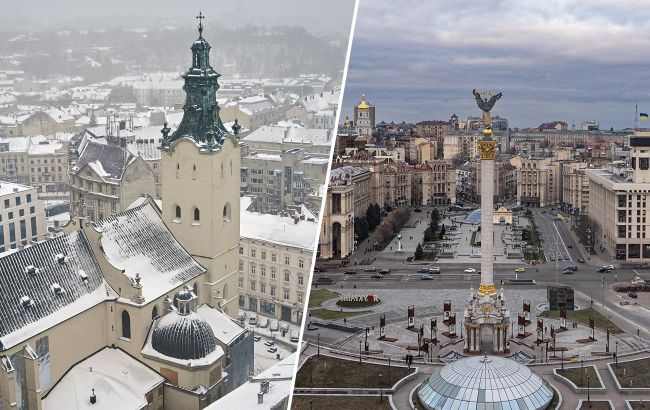 Ukrainian cities that developed faster than Europe in medieval times (collage: RBC-Ukraine)
European values of self-governance and economic freedom reached Ukrainian cities long before modern Europe. Magdeburg Law, which began spreading across Ukrainian lands as early as the 14th century, created governance systems often more progressive than practices in major Western capitals.
RBC-Ukraine has compiled stories of 10 Ukrainian cities where Europe began not just in words, but in laws and everyday life.
The process of Ukrainian cities receiving the Magdeburg Law began in the 13th century from Western cities and eventually spread across the entire territory.
Magdeburg Law was a medieval constitution for cities, originating in the German city of Magdeburg in the 12th century. It became the most widespread system of municipal self-governance in Europe, turning cities into independent states within a state.
Kyiv: city of contracts and independent courts
Kyiv received the Magdeburg Law between 1494 and 1499, depending on sources. The law radically transformed Kyiv as an urban organism. The city gained autonomy from direct administrative rule by the voivode—key decisions were made by elected citizen bodies.
An independent city court handled civil and property cases without interference from princely or royal authorities. For craftsmen and merchants, this meant stable rules, property protection, and predictable taxes. Kyiv gradually evolved from a “border center” into a city of contracts, agreements, and accountability.
Lviv: where economy outpaced politics
In Lviv, the Magdeburg Law created an environment where the economy moved faster than politics. Guilds regulated product quality, the city council handled taxes and infrastructure, and the city court resolved disputes between residents.
This fostered a strong middle class of artisans, merchants, and bankers. Lviv became a city where social status was defined by participation in economic life rather than heritage, a very European scenario for the 14th–15th centuries.
Kamianets-Podilskyi: crisis management on the frontier
Here, Magdeburg Law acted as crisis management. Kamianets existed in constant border tension, but self-governance allowed rapid mobilization of resources—for fortifications, trade, and logistics.
Citizens controlled customs, fairs, and artisan districts, creating a city capable of independent survival under war and transit challenges—a capacity many Western cities lacked at the time.
Lutsk: vertical city responsibility
In Lutsk, self-governance established a clear vertical of municipal accountability. The mayor, council, and court acted as checks and balances, reducing abuse of power and promoting crafts and trade.
For residents, this meant predictability—contracts were enforced, debts collected, and courts worked regularly. Lutsk effectively operated under rule-of-law principles long before the concept existed.
Mukachevo: catalyst for multicultural development
Magdeburg Law in Mukachevo became a catalyst for multicultural growth. The city attracted Hungarian, German, and Ruthenian artisans and merchants by guaranteeing equal legal conditions.
This reduced ethnic conflict and strengthened economic integration. Mukachevo became a regional trade hub where rules mattered more than origin.
Volodymyr: from princely rule to civic power
In Volodymyr (Volodymyr-Volynsky), city law marked the shift from princely administration to a community-driven governance model. The city received its privileges around 1324. Residents oversaw taxes, trade, order, and courts.
This fostered a culture of participation; the city no longer awaited “top-down” decisions but made them independently. This model became a foundation for sustainable urban development in the following centuries.
Drohobych: salt trade under legal protection
Drohobych’s salt industry required precise legal regulation. Magdeburg Law ensured quality control, property protection, and fair profit distribution.
Citizens became co-owners of the city’s economic success. This transformed Drohobych into a wealthy city with an advanced urban culture.
Sambir: efficiency in a small city
In Sambir, self-governance made the city attractive to settlers and businesses. Its small scale allowed quick decision-making, and legal autonomy prevented feudal interference.
Sambir demonstrates how Magdeburg Law worked not only in large centers but also in small but effective cities.
Ostroh: synergy of law, intellect, and education
Ostroh combined city law with intellectual breakthroughs. Self-governance created a safe environment for education, printing, and science.
The city became a platform for elite formation, not just a trade point, a rare 16th-century synergy of law, economy, and culture.
Kremenets: stability and municipal governance
In Kremenets, Magdeburg Law stabilized social relations. Citizens had clearly defined rights and responsibilities, reducing conflicts and encouraging investment in crafts and trade. The city functioned as a self-regulating system, a model of effective municipal governance.
Magdeburg Law didn’t just “Europeanize” Ukrainian cities; it rewired the mindset: from subjects to citizens, from orders to contracts, from force to law.
That’s why the claim that Ukraine is learning from Europe is historically inaccurate. Ukraine has its own European urban tradition interrupted, but not destroyed.
You might also be interested in:
-
A famous Ukrainian who invented the X-ray but never received a Nobel Prize
-
Where to find the oldest village in Ukraine and what makes it unique
Sources: T. Hoshko, Essays on the History of Magdeburg Law in Ukraine 14th–early 17th centuries, Encyclopedia of the History of Ukraine, Central State Historical Archive of Ukraine