EU trend shift: Countries cut benefits for Ukrainian refugees as support policies tighten


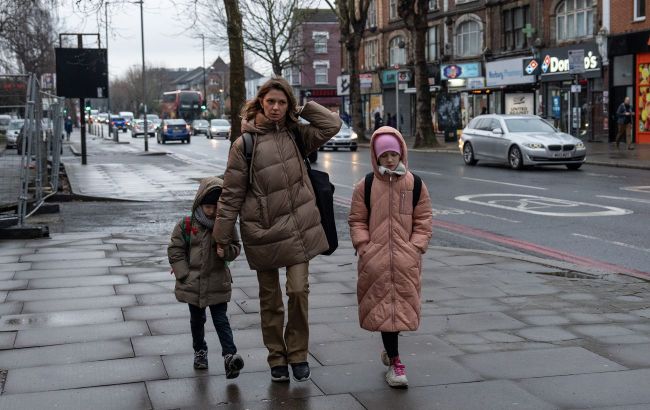 In some European Union countries rules for Ukrainians and refugee support are changing (illustrative photo: Getty Images)
Today, the reduction of social benefits for Ukrainians and stricter conditions for receiving them are a general trend in countries of the European Union.
In which European Union countries was assistance to Ukrainians reduced
Postdoctoral researcher of Kyiv School of Economics Dariia Mykhailyshyna said in a comment to RBC-Ukraine that the most generous country toward Ukrainians (in terms of direct payments) remains, probably, Germany.
She noted that at first Ukrainians had access to Bürgergeld (so-called citizens' allowance) at the same level as citizens, rather than to lower payments under the law on asylum seekers.
This meant free housing, medical care, education, and cash assistance.
In addition, this made it possible to receive 563 euros per person per month.
"But with the arrival of the Merz government at the beginning of 2025 situation changed: for those who arrived after 1 April 2025, transition to lower payments under the system for asylum seekers is provided for," the expert recalled.
In addition, "at the end of June 2025 Bundestag voted to suspend the right to family reunification for refugees."
At the same time, two-thirds of Germans support the cancellation of Bürgergeld for Ukrainians and the return home from Germany of Ukrainian men of conscription age.
Norway also stood out for high payments for Ukrainians. But since 2025, support there has been significantly limited.
Payments of 564 euros are now granted only to those who live in state dormitories, not in private housing.
Admission to the dormitories of refugees with pets has also been canceled.
In addition, free dentistry for youth under 24 became available only after 5 years of residence in the country.
Since August 2024, Ireland has finally equalized payments for all Ukrainians living in state housing.
Now, regardless of arrival date, assistance amounts to 38.80 euros per week (instead of the previous 220 euros).
At the same time, the reduction did not affect those who rent private housing or live with Irish families.
In Czechia, since the autumn of 2024 period of free accommodation has been reduced to three months. And to extend protection, a notarized confirmation of rent is required.
Payments since 2025 amount to 200 euros for adults and 143 euros for children.
However, if an employable refugee does not find a job within 150 days, assistance is reduced to a subsistence minimum of 129 euros per month.
Meanwhile opinion that "Ukrainians are rather a benefit than a threat for Czechia" is supported by 31% of the country's residents.
"60% of respondents believe that Ukrainians receive from the budget significantly more than they pay into it. Although from the official statement of relevant institutions we know that everything is opposite," said STEM analyst Jiří Táborský.
Poland is currently moving along the path of the strict linking of social assistance to employment.
Thus one-time payment of 300 zlotys was canceled back in summer 2022.
And child payments 800+ (monthly assistance of 800 zlotys for each child under 18) are now tied to official employment or entrepreneurial activity.
Mykhailyshyna explained that this is the result of a bill signed on 13 September 2025 after President Karol Nawrocki vetoed the previous version.
At the beginning of January 2026 attitude of Poles toward Ukrainian refugees worsened to a historic minimum: now their support is approved by 48% of respondents, while 46% are against.
At the same time, the most skeptical are rural residents, people with low incomes, and supporters of right-wing parties.
In addition, more than half of the residents of Poland support the end of the war (even at the cost of territorial concessions by Ukraine), and 63% consider such a scenario inevitable.
Earlier, Poland officially announced the end of temporary protection for Ukrainians on 4 March 2026, although the general decision of the European Union provides for its validity until 2027.