Estonia prepares defense plan in case of Russian occupation

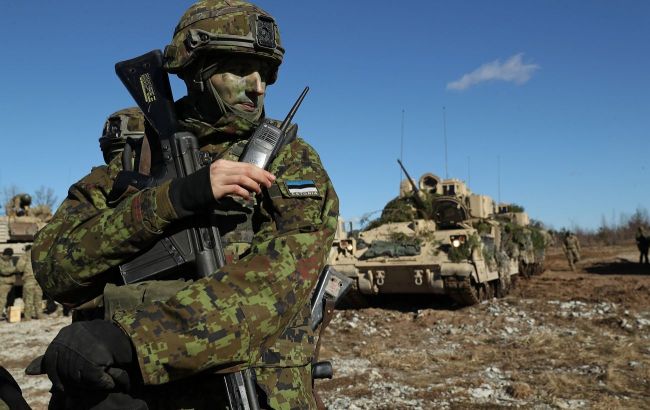 A soldier of the Estonian army (Photo: Getty Images)
Estonia is preparing for a scenario of a complete blockade by an aggressor. The country must now be capable of holding out for 30 days without external assistance. However, the Estonians will not simply defend themselves — they will respond with strikes deep into enemy rear areas, according to the ERR portal.
The new security principle calls for maximum autonomy. If Estonia is blockaded from the air, sea, and land, society must function independently. This regime will last at least one month. That is the amount of time allotted to restoring external communications and to obtaining full support from NATO forces.
Requirements for the population have also become stricter. Every citizen must ensure their own autonomy for seven days. This is the minimum survival threshold without state assistance.
Main priorities for the population:
- Uninterrupted access to energy and communications;
- Availability of food and fuel supplies;
- Access to medical services;
- Operation of public media for receiving information.
"Active defense": Military operations will be moved onto enemy territory
Tallinn is changing its approach to warfare. The previous principle of territorial defense has been significantly expanded, and the army now plans to act preemptively. The main goal is to prevent large-scale battles on Estonian soil.
The military plans to carry out deep strikes, which will allow them to destroy enemy forces before they cross the border. Such a strategy aims to reduce civilian casualties.
The document clearly states:
"Military defense is based on the principle of active defense, whereby active measures are employed against enemy forces to prevent or hinder an attack or reduce its effectiveness, including deep strikes on the enemy's territory. Territorial defense still plays an important role, but the objective is to ensure that combat operations do not take place on Estonian soil."
Russia remains the main threat to Europe
Since Moscow has not abandoned its imperial ambitions, it is recognized as the greatest danger to the Euro-Atlantic area. The updated strategy notes that Russia is a country whose imperialist aggressive policy is aimed at dismantling and reshaping the European security architecture and the rules-based world order, and restoring its sphere of influence.
Tallinn also draws attention to the aggressor's allies. The document mentions China, North Korea, Belarus, and Iran.
What is happening around NATO
Despite differing opinions among some members regarding Ukraine's accession to NATO, Estonia strongly counts on our support. Estonia has emphasized that Europe itself needs security guarantees from Ukraine, as the Ukrainian army is the strongest in the region, and there is a historic moment for integration.
Meanwhile, the Alliance is trying to shed its dependence on the US against the backdrop of Trump's presidency and the war in Iran. NATO Secretary General Mark Rutte, speaking in Washington, announced a transformation of the transatlantic alliance.