Energy blackmail or election campaign: What's driving Orbán and Fico's standoff with Ukraine

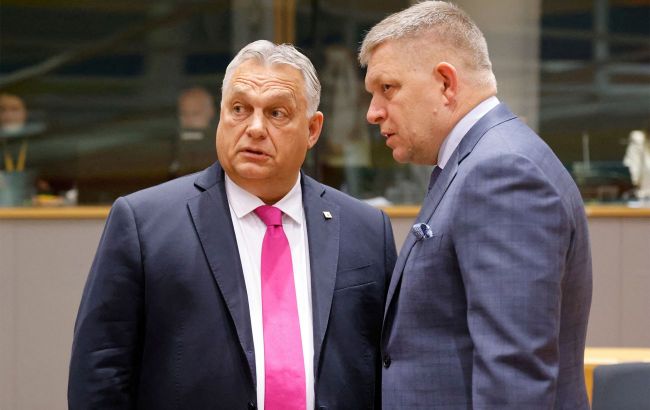 Viktor Orbán and Robert Fico (photo: Getty Images)
Hungary and Slovakia, in recent days, have effectively declared "war" on Ukraine, threatening to leave it without energy resources and financial support.
RBC-Ukraine explains why Viktor Orbán and Robert Fico decided to target Ukraine right now — and what could happen next.
Read also: Slovak opposition to file criminal complaint against Fico over Ukraine electricity halt
Key points
- Energy blackmail. Hungary and Slovakia have suspended supplies of diesel fuel and electricity to Ukraine, accusing Kyiv of deliberately halting the transit of Russian oil through the Druzhba pipeline.
- Blocking EU aid. Budapest has blocked the allocation of €90 billion in EU loans to Ukraine and the 20th package of sanctions against Russia, demanding the immediate restoration of pipeline operations.
- Political motives. The escalation is linked to upcoming parliamentary elections in Hungary, where Viktor Orbán is using the image of an “external enemy” and foreign pressure as part of his campaign strategy.
- Ukraine and EU position. Kyiv rejects the accusations, stressing that Russian attacks on infrastructure caused the disruption. The European Council says Hungary is violating cooperation principles but is urging Ukraine to restore Druzhba as soon as possible.
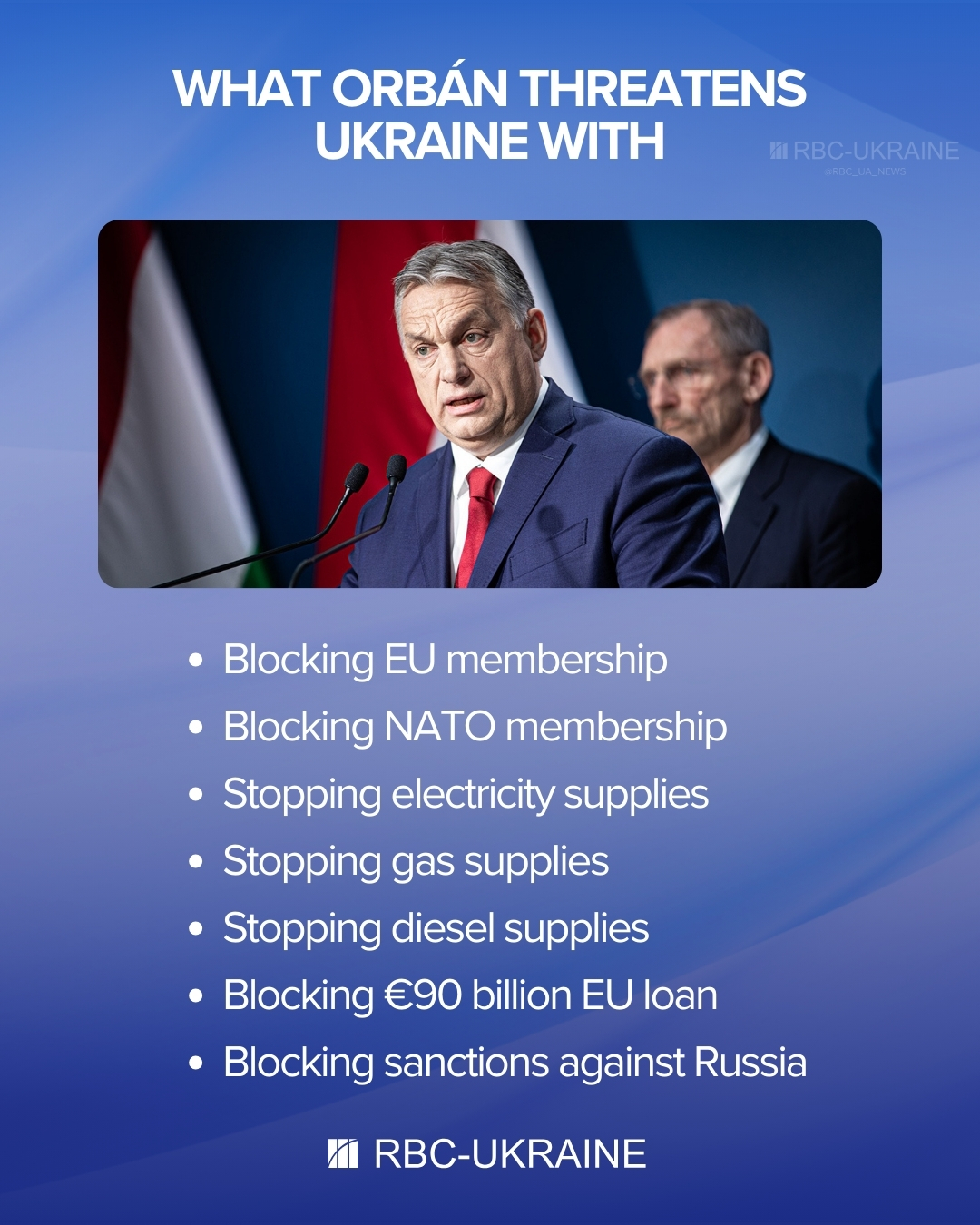
Viktor Orbán and his rhetoric (infographic: RBC-Ukraine)
What happened
Relations between Kyiv and both Budapest and Bratislava have not been easy in recent years. However, the past week has seen a particularly sharp escalation.
On January 27, Ukraine announced that oil transit through the Druzhba pipeline had been suspended due to a Russian attack on pipeline infrastructure in the Lviv region.
On February 18, Hungarian Foreign Minister Péter Szijjártó said Hungary was suspending diesel supplies to Ukraine, accusing Kyiv of deliberately delaying pipeline repairs and using the issue as political leverage. Budapest also announced it would halt emergency energy supplies to Ukraine.
The Slovak government joined the criticism. Prime Minister Robert Fico claimed that the supply stoppage was the result of a political decision by President Volodymyr Zelenskyy, who he accused of “playing games” and harming Slovakia’s and Hungary’s economic interests. He also announced the suspension of emergency electricity supplies from Slovakia to Ukraine.
Ukraine rejected all accusations, reiterating that Russian attacks caused the transit halt. Foreign Ministry spokesperson Heorhii Tykhyi said Orbán’s and Fico’s actions resembled the “behavior of addicts.”
Ukraine and Croatia also expressed readiness to offer alternative supply routes. The European Commission responded by stating it is not imposing deadlines on Ukraine for pipeline repairs but remains in contact with the government on the issue.
However, the “affected” countries insist specifically on restoring Druzhba’s operations. Hungary has officially blocked the €90 billion EU loan package for Ukraine and the 20th sanctions package against Russia.
“Hungary will block it. Until Ukraine restores oil transit to Hungary and Slovakia via the Druzhba pipeline, we will not allow decisions important for Kyiv to be adopted,” Hungary’s Foreign Ministry said.
At the same time, the EU approved the loan framework in principle and hopes to persuade Orbán to lift his veto by the end of March, when the borrowing process is expected to begin.
Ukraine’s Foreign Minister Andrii Sybiha condemned Hungary’s “blackmail” and called for constructive dialogue.
Read also: EU to propose full ban on Russian oil after Hungary elections, Reuters reports
On February 24, President Volodymyr Zelenskyy again emphasized that Russia was responsible for damaging the pipeline.
“It's up to Orbán to speak with Putin, maybe an energy ceasefire or something like this,” Zelenskyy said. European Council President António Costa added that the Druzhba shutdown and EU loans to Ukraine are unrelated, and that Hungary is violating principles of fair cooperation.
European Commission President Ursula von der Leyen condemned Russian attacks on energy infrastructure but urged Ukraine to accelerate Druzhba repairs.
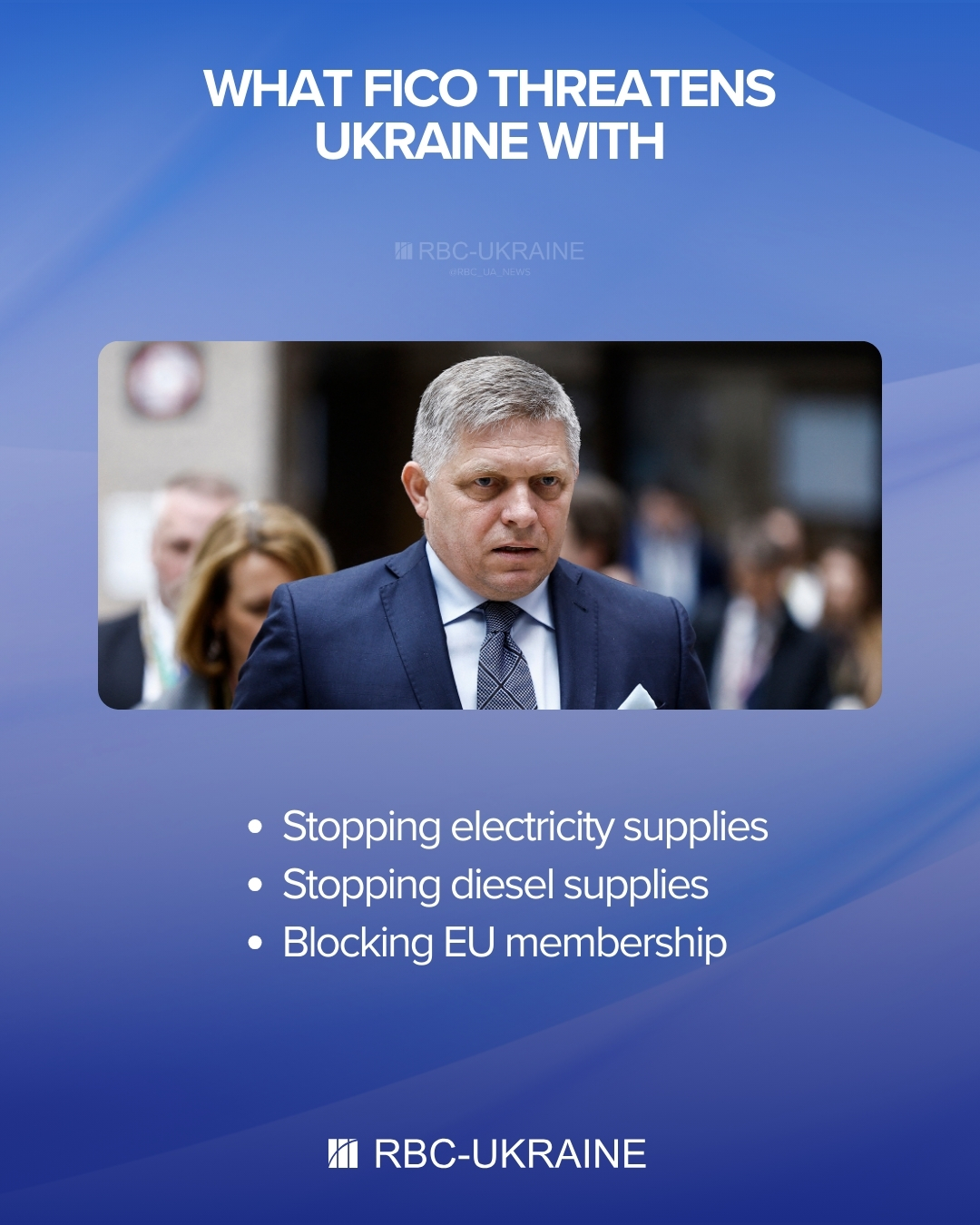
Slovak leader against Ukraine (infographic: RBC-Ukraine)
Why Orbán and Fico escalated now
Technically, Orbán and Fico are not exaggerating — oil supplies through Druzhba are indeed important for their countries. It is also true that their governments have ignored diversification opportunities for years.
At the same time, Hungary and Slovakia are not under blockade and have alternative supply routes. If this were purely an energy dispute, it could likely have been resolved more calmly, without public accusations and blackmail.
The current conflict is driven by politics. Hungary will hold parliamentary elections in about six weeks, which are expected to be challenging for the ruling party. Orbán could potentially lose his position as prime minister.
One of his key campaign strategies is exposing alleged “foreign influence.” In this context, escalating the Druzhba dispute may be a calculated move — possibly even a provocation.
Orbán stands to benefit either way. If Ukraine or the EU makes concessions, he can present himself as a successful negotiator. If not, he can further rally voters around the narrative of “unity against foreign pressure.”
Both Ukraine and the EU recognize Hungary’s attempt to turn foreign policy into a campaign tool. The Financial Times recently reported that the European Commission has intentionally toned down public criticism of Orbán to avoid giving him grounds to claim EU interference in Hungary’s elections.
Ukraine’s Foreign Minister Andrii Sybiha has also urged Budapest to stop dragging Ukraine into Hungary’s domestic politics.
Slovakia’s involvement is also understandable. Disruptions to Druzhba affect its economic interests, and Fico already faces domestic economic challenges. On issues related to Russian oil, Hungary and Slovakia have traditionally acted together.
However, Slovakia’s rhetoric has been noticeably less aggressive. The main driver of the conflict appears to be the Hungarian government.
What to expect next
The dispute over the pipeline itself could be resolved relatively soon. But that does not mean relations between Ukraine and its western neighbors will immediately normalize.
Hungary’s government has portrayed Ukraine and the EU as adversaries to rally domestic support. It is possible that once the Druzhba issue is settled, a new “threat” will emerge, allowing Orbán to position himself as defending Hungary. This dynamic may last at least until mid-April — and potentially longer if Orbán wins re-election.
Robert Fico is also not Ukraine’s easiest neighbor, but the likelihood of a truce with Slovakia appears higher. Fico’s announced cutoff of electricity turned out to mean the end of emergency assistance, while commercial electricity sales to Ukraine continue.
Read also: 'Ultimatums should be sent to Kremlin': Ukraine responds to Orban and Fico
Slovakia also did not block the EU sanctions package or the loan for Ukraine. In the Orbán–Fico tandem, Orbán has consistently been the more confrontational figure. The Slovak prime minister may use anti-Ukrainian rhetoric, but he tends to be far more pragmatic when money is involved.
However, the current dispute ends, it is worth remembering that it is not extraordinary. Since the start of the full-scale war, there have been numerous Ukrainian-Hungarian clashes involving mutual accusations and the subsequent blocking of assistance.
It is also worth noting something else. Hungary has once again demonstrated how certain countries — or rather certain individuals — can sabotage pan-European decisions. This situation is not new either.
At one point, Chancellor Olaf Scholz even began inviting Orbán "for coffee" to prevent him from once again derailing a vote on Ukraine’s European integration.
Yet the problem still exists. It is evident now that Ukraine is seeking another round of financial assistance. And it will take on entirely new dimensions later, when the issue of Ukraine’s accession to the European Union comes to the forefront.
Quick Q&A
Why did Hungary and Slovakia suspend emergency energy supplies to Ukraine?
Budapest and Bratislava accuse Ukraine of deliberately halting the transit of Russian oil through the Druzhba pipeline. Viktor Orbán and Robert Fico describe it as “political games” and a tool of pressure, while Kyiv insists the stoppage was caused solely by Russian attacks on infrastructure in the Lviv region.
What measures is Viktor Orbán threatening in response to the oil dispute?
The Hungarian government has officially announced it will block two decisions critical for Kyiv: the allocation of a €90 billion EU loan and the adoption of the 20th sanctions package against the Russian Federation. Budapest says it will maintain its veto until oil transit is fully restored.
What role do Hungary’s domestic elections play in this conflict?
Escalating the dispute appears to be a deliberate campaign strategy by Orbán. By portraying Ukraine and the EU as an “external enemy,” he seeks to rally voters around the idea of defending national interests from foreign influence ahead of challenging parliamentary elections.
What is the difference between Orbán’s and Fico’s positions on Ukraine?
Although the two prime ministers are acting in tandem, Slovakia’s rhetoric has been less combative. Unlike Hungary, Bratislava has not blocked financial assistance or sanctions.
Sources: statements from Ukrainian and European politicians, the Financial Times, and Radio Free Europe/Radio Liberty.