Don't miss Orionids 2026: Best time and place to watch meteor shower

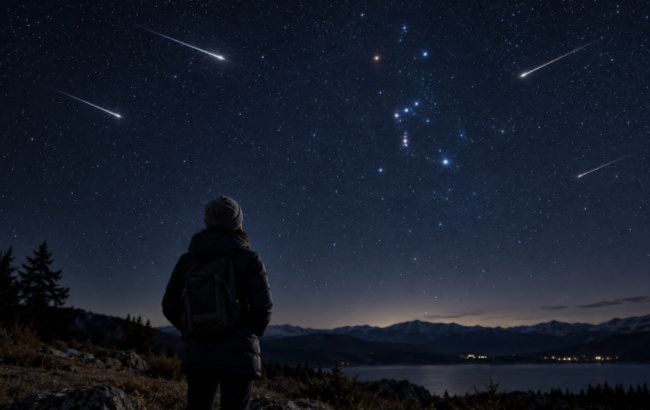 Orionid meteors leave bright streaks across the night sky (photo: Styler)
In October, Ukrainians can watch one of the annual meteor showers—the Orionids. Under favorable conditions, observers may see 10–20 meteors per hour, although a bright Moon will make viewing more difficult this year.
RBC-Ukraine explains when to watch the shower in Ukraine, where to look for meteors in the sky, and what makes the Orionids special.
When can Ukrainians see Orionids peak?
The Orionid meteor shower is active every year from around October 2 to November 7. In 2026, it will peak on the night of Wednesday, October 21, into Thursday, October 22.
According to the International Meteor Organization (IMO), under ideal viewing conditions, observers may see around 10–20 meteors per hour. This is an estimate, not a guarantee: actual visibility depends on cloud cover, light pollution, the Moon's position, and the observation site.
This year, the sky will not be completely dark throughout the night. The Moon will be waxing and will illuminate a significant portion of the sky, making fainter meteors harder to spot.
Therefore, the best time to observe the Orionids is during the predawn hours, after the Moon has set. The exact moonset time depends on your location, so check a local astronomical forecast before heading out.
Where to look for Orionids in Ukraine
You can observe the Orionids in both the Northern and Southern hemispheres. Ukraine is in the Northern Hemisphere, so the meteor shower will be visible there, weather permitting.
According to the Royal Museums Greenwich, the Orionids are named after the constellation Orion. The radiant, the point in the sky from which the meteors appear to emerge, lies in the direction of this constellation. However, this is just a perspective effect: the bright streaks can actually appear across different parts of the sky.
To improve your chances of spotting meteors, travel away from bright city lights. An open area with a wide view of the sky is ideal, with no trees, buildings, or other obstacles blocking the horizon.
No special equipment is needed: the naked eye is enough to observe meteor showers. Binoculars and telescopes are not necessary, as meteors can flash across any part of the sky overhead.
Your eyes also need time to adjust to the darkness. Avoid constantly looking at your phone screen or turning on a bright flashlight, as this can impair your night vision.
Why Orionids are linked to Halley's Comet
The Orionids occur when Earth passes through a trail of particles left behind by comet 1P/Halley. As the comet travels around the Sun, it sheds material, including dust and small fragments. When Earth crosses this region of space, the particles enter the atmosphere and create bright flashes of light.
NASA notes that Orionid meteors travel at around 66 kilometers per second. This speed makes them some of the fastest meteors visible during the year.
Interestingly, Halley's Comet is linked to more than just the Orionids. Another annual meteor shower, the Eta Aquariids, which peaks in May, also forms from particles left behind by the comet.
Notably, Halley's Comet itself is not a meteor. The comet returns to the inner solar system approximately every 75–76 years. Earth, however, regularly crosses its dust trail, which is why we can observe the Orionids every year.
Is it worth watching for meteors over several straight nights?
Yes. Although activity peaks on the night of October 21–22, meteors may also be visible before and after the peak, as the shower remains active for several weeks.
If clouds obscure the sky over your city on the peak night, try observing on another clear night during the Orionids' active period. However, you may see fewer meteors than at peak.
For observers in Ukraine, the key conditions for successful viewing are clear skies, a location away from bright lights, and good timing. Don't limit your gaze to the constellation Orion; meteors can streak across any part of the sky.