Biggest meteor shower of the year: When and where to watch Perseids peak

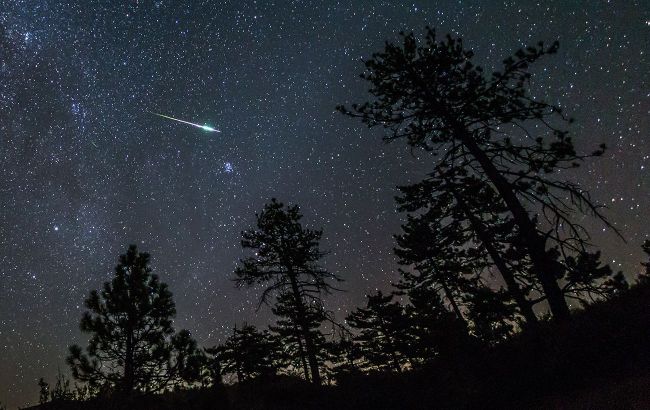 Photo: Perseid meteor shower (Getty Images)
On the night of August 12–13, skywatchers around the world will have a chance to see the peak of one of the year's best-known meteor showers – the Perseids. The best viewing conditions will come during the second half of the night, according to the International Meteor Organization (IMO) and NASA.
Key points:
- The shower is known not only for its large number of streaks of light but also for bright fireballs – meteors that flare up in the sky and leave visible trails.What makes the Perseids special:
- Where and how to watch: It is best to get out of the city and away from artificial light. Telescopes and binoculars are not needed – the meteors can be seen with the naked eye.
- Ideal conditions: The Moon will favor observations this year. It will be a thin crescent far from the constellation Perseus, so its light will not interfere with seeing even faint meteors.
- Meteor shower peak: The Perseids will reach their highest activity on the night of August 12–13. The best time for viewing will be during the second half of the night.
The Perseids are active every year from approximately July 17 to August 24. They occur as Earth passes through a stream of particles left behind by Comet 109P/Swift-Tuttle. The meteor shower gets its name from the constellation Perseus, which is where the meteors appear to originate.
When will the Perseids peak?
The peak of activity will occur on the night of August 12–13.
In the evening of August 12, you may see around 5 meteors per hour, while by midnight their number could increase to approximately 10 per hour.
During the early morning hours, activity will increase much more rapidly. Around 3 a.m. local time, the number of meteors could reach nearly 40 per hour under favorable viewing conditions.
Under ideal conditions, the Perseids can produce 50–100 meteors per hour. However, the IMO's 2026 forecast is somewhat more cautious: experts estimate that this year's activity could be below average.
It is impossible to see every meteor, because the shower's radiant – the point from which the meteors appear to emerge – does not rise high enough for the entire shower to be visible at any given moment.
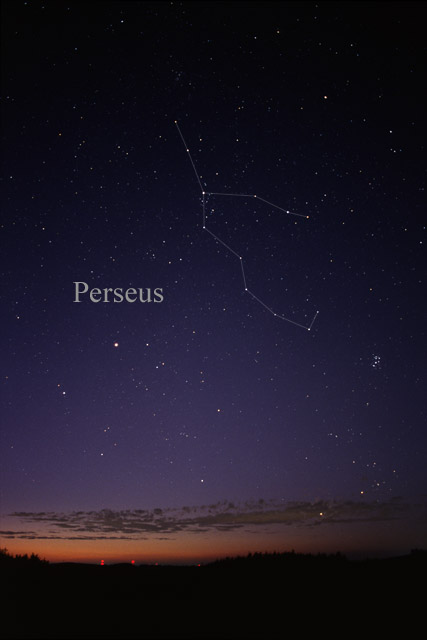
The constellation Perseus (photo: wikipedia.org)
Will the Moon interfere?
This year, viewing conditions for the Perseids will be especially favorable because of the Moon’s phase.
On August 5, the Moon reached its last quarter, and by August 9 it had become a thin crescent and moved farther away from the constellation Perseus. As a result, its light should not interfere significantly with observations during the peak night.
This is important because bright moonlight can wash out faint meteors, making them harder to spot with the naked eye.
Where is the best place to watch?
For the best view of the Perseids, head away from the city to a location with as little artificial light as possible.
No special equipment is needed: the meteors can be seen with the naked eye. Before watching, give your eyes 20–30 minutes to adjust to the darkness.
If you're watching in the evening, look toward the north and northeast. Around midnight, the radiant will rise higher, and afterward meteors will begin appearing across different parts of the sky.
At the same time, experts recommend not looking directly at the radiant. Instead, keep it near the edge of your field of view. This makes it easier to distinguish Perseids from sporadic meteors.
It's best to watch for at least an hour. Meteor shower activity is uneven: you may see nothing for several minutes and then suddenly spot several meteors in a short period.
Why are the Perseids worth watching?
The Perseids are considered one of the most popular meteor showers of the year. People have been observing them for more than 2,000 years.
The special feature of the shower is not only the large number of meteors. The Perseids are also known for bright fireballs – exceptionally luminous meteors that can leave glowing trails behind them.
You don't have to be a professional astronomer to observe the shower. Systematic observations by amateurs also have scientific value: records of the time, brightness, color and other characteristics of meteors help researchers study meteor shower activity.
On August 12, another astronomical event will take place alongside the Perseid peak – a solar eclipse. It will be partial and visible only from certain regions of Earth. In Ukraine, it will be visible only partially.