Daily or every 2–3 weeks? How often Russia can repeat massive attacks


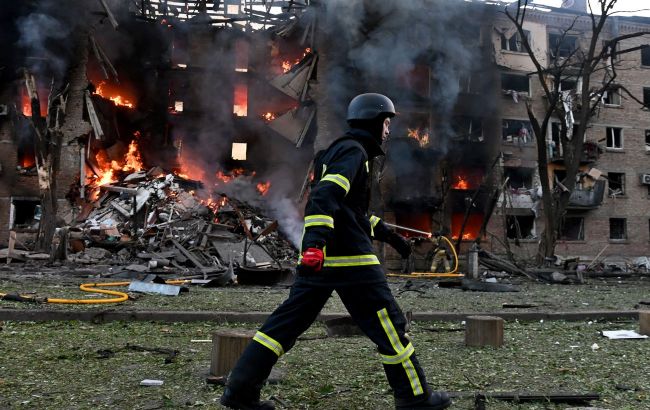 Photo: The aftermath of a massive Russian attack on Kyiv on May 24 (Getty Images)
Following one of the most massive strikes on Kyiv, the Kremlin has turned to diplomatic pressure, threatening Western embassies with systemic attacks on the capital. At the same time, Ukraine reports critical air defense shortages.
Can Russia turn its threats into daily terror, how often can the enemy repeat massive attacks, and will the use of Oreshnik missiles become regular? Read more in the RBC-Ukraine report.
Background: one of the most massive attacks on Kyiv and the Kremlin’s ultimatum
On the night of May 24, during which the enemy used almost its entire available range of weapons, from Shahed drones to ballistic Kinzhal and Zircon, and even Oreshnik missiles, Moscow resorted to another act of blackmail.
Russia’s Foreign Ministry issued an ultimatum, declaring the start of "systematic strikes" on Kyiv and calling on foreign diplomats to urgently leave the city. Russian Foreign Minister Sergey Lavrov even called US Secretary of State Marco Rubio to officially deliver this warning to President Donald Trump.
In response, Ukraine called Russia’s statements intimidation and blackmail that will not work. The European Union made it clear that Western diplomats will not leave the Ukrainian capital.
Whether Russia is really capable of sustained massive attacks and what strategy the Kremlin is pursuing? RBC-Ukraine asked experts.
How often are massive strikes possible?
Experts agree that Russia’s ability to carry out continuous large-scale attacks is limited by its industrial capacity. Analyst at the Ukrainian Center for Security and Cooperation Anton Zemlianyi notes that the enemy is consuming missiles immediately after they are manufactured.
"Russians use the number of missiles they produce. For example, the production of Iskander-M is about 60 units per month, while during spring attacks they used around 150. This means they cannot scale up to daily strikes," Zemlianyi explains.
According to the analyst’s estimates, mass attacks are possible, but only with an interval of two to three weeks, which is needed to accumulate sufficient stockpiles.
Executive Director of the Ukrainian Center for Security and Cooperation Dmytro Zhmailo confirms this assessment, emphasizing the security risks for Russia itself.
"Each attack requires force buildup, and concentrating a large amount of weapons in one place carries the risk of a retaliatory strike by the Defense Forces. Therefore, on average, they can launch strikes once every three weeks," Zhmailo notes.
Overall, the expert says Russia is capable of producing up to 200 missiles per month (including the full range: Kh-101, ballistic, aeroballistic, and cruise missiles).
Can Oreshnik strikes become regular?
Regarding the intermediate-range ballistic missile Oreshnik, expert Anton Zemlianyi notes that although two strikes have already been recorded since the beginning of 2026 (the first took place in 2024), this does not yet indicate a systemic deployment.
"They are produced in single units. Their use is possible purely for propaganda purposes — perhaps once every six months for psychological effect and to create a victory image for the Russian military leadership and domestic audience," the source says.
"As for other missiles, such as Zircon or Onyx, their use is possible, perhaps even slightly more frequently than before," Zemlianyi suggests.
The enemy keeps this type of weapon in strategic reserve, including for a potential conflict with NATO. Earlier, Ukraine’s Defense Intelligence (HUR) reported that Russia planned to produce up to 10 Zircon missiles per month, but actual production rates dropped to about 3 missiles per month. Over two years, around 200 units have been produced. Their future use is possible, but these will be isolated incidents rather than mass strikes.
What goals is Moscow pursuing?
Experts identify several strategic objectives of the Kremlin:
- Psychological pressure on the West — to intimidate partners into pressuring Kyiv to accept peace on Moscow’s terms.
- Information victory — an attempt to force diplomats to leave Kyiv. If Western embassies leave the capital, Russia would use it in propaganda: "Ukraine has been abandoned, it is collapsing."
- Shifting responsibility — by warning about strikes, Russia tries to legitimize damage to diplomatic facilities, blaming countries that ignored the warnings.
"They are constantly looking for our weak points. While they relied on sheer numbers in 2024, now they are trying to flip the chessboard with information operations to compensate for the lack of strategic success on the battlefield," summarized Dmytro Zhmailo.
Amid Russian air attacks, President Volodymyr Zelenskyy sent an urgent letter to US President Donald Trump, warning about a critical shortage of air defense systems and interceptor missiles, primarily those used to intercept ballistic threats.
The European Union summoned the Russian Chargé d’Affaires over Russia's threats to strike Kyiv and its recommendations to evacuate foreign diplomats.