Crimea commanders accused of falsifying documents to push conscripts to frontline

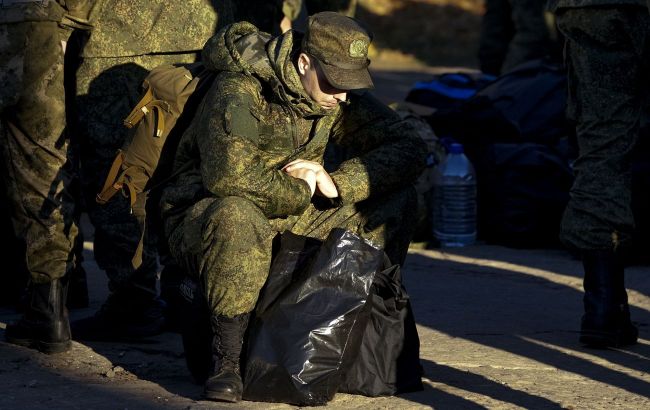 Photo: Russian commanders in Crimea forge documents for conscripts and send them to the front (Getty Images)
Russian commanders in temporarily occupied Crimea are massively falsifying documents of conscripted soldiers, transferring them to contract service without their consent, according to the Telegram channel of the partisan movement Atesh.
Read also: Putin readies hidden draft in 2026 amid heavy losses — ISW
An agent of the movement from one of the units of the 810th Separate Guards Naval Infantry Brigade stationed in Crimea reported a systematic practice of illegally transferring conscripts to contract service.
What is happening in his unit is a well-established scheme operating across the entire brigade and other units on the peninsula.
Commanders first try persuasion — promising money, benefits, and easy service. When that fails, threats begin: being sent to a penal battalion, to frontline infantry, or having their service made unbearable. If that still does not work, signatures are simply forged.
"I personally saw a sergeant sign for three guys at once. The same handwriting on all the documents. The guys only found out when they were issued orders to be sent to the combat zone," the agent said.
He emphasizes that this is not an exception, but the norm. In his unit alone, more than 15 people have been "processed" this way over the past two months. A similar pattern exists in other Russian Armed Forces units across Crimea — the system operates under a single scenario.
It is noted that Russia is experiencing an acute manpower shortage, especially in naval infantry units suffering heavy losses on the frontline. Conscripted soldiers are the most vulnerable category — the easiest to pressure, deceive, or simply falsify documents for.
Mobilization in Russia
Earlier, Ukrainian intelligence reported that Russia is facing financial difficulties and significant battlefield losses. This could force Russian dictator Vladimir Putin to consider a pause in the war or make difficult decisions regarding mobilization.
According to Commander-in-Chief of the Armed Forces of Ukraine Oleksandr Syrskyi, Russia plans to draft more than 400,000 people into the army in 2026 and form at least 11 divisions.
In addition, in the temporarily occupied territories of Donetsk and Luhansk regions, Russia has launched total forced mobilization, increasingly resembling the deliberate "disposal" of the local population.
Previously, it was reported that in 2026 Russians plan to recruit nearly 67,000 people to replenish their units. To achieve this, they intend to enlist residents of occupied Ukrainian territories under contract.
There have also been reports of a large-scale recruitment of reservists in Russia under the pretext of protecting critical infrastructure facilities. According to available information, the formation of such units has begun in at least 20 regions of the country.
Analysts from the Institute for the Study of War emphasize that the Kremlin is effectively conducting a forced partial draft as part of creating a so-called "active reserve." Despite official statements, these individuals are being prepared for participation in combat operations against Ukraine.
In addition, Russian occupation authorities are attempting to legalize the forced mobilization of residents of temporarily occupied Ukrainian territories. Russia has adopted a law allowing conscription throughout the entire year — from January 1 to December 31 — formally extending it to occupied Ukrainian regions.