Putin readies hidden draft in 2026 amid heavy losses — ISW

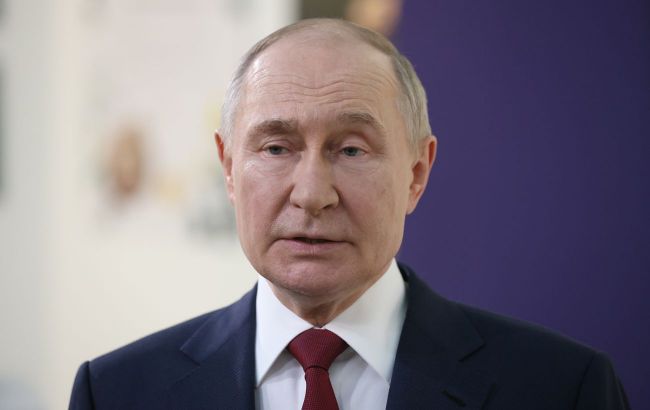 Photo: Vladimir Putin (Getty Images)
Russian President Vladimir Putin is creating the informational conditions for the resumption of limited, staggered conscription of reservists. In this way, Russia is trying to compensate for its losses in the war against Ukraine, according to the Institute for the Study of War (ISW).
Analysts note that a series of recent decisions by the Russian authorities indicate preparations for the conscription of reservists.
On February 18, the Russian State Duma passed a bill in its first reading that would strengthen preventive measures against evading the duty to defend the Fatherland. The document will likely give Moscow the ability to punish Russians who criticize the conscription of reservists.
Russia has also banned Telegram, which may be an attempt to limit criticism of the government.
ISW believes that Putin wants to normalize limited, sequential conscription to maintain the size of the occupation army so as not to carry out a partial mobilization, as in 2022, which resulted in up to 900,000 Russians leaving the country.
Limited conscription is intended to maintain the level of Russian military losses on the front lines; it is not intended to reinforce Russian troops with additional forces.
Analysts note that the Kremlin is setting the conditions for the phased conscription of reservists on a compulsory basis from at least October 2025, when the Russian government allowed reservists to be deployed in expeditionary missions outside Russia without officially declaring mobilization or martial law.
In November, Putin signed a decree allowing Russian military commissariats to conduct conscription processes throughout the year. In December, Putin approved a decree on the compulsory conscription of reservists for military training in 2026, presumably to secretly conscript his strategic reserve.
Analysts note that the Kremlin is preparing for the forced conscription of a limited number of reservists from a position of weakness to compensate for the almost complete exhaustion of its expensive voluntary recruitment system in 2026.
In this way, Putin continues to seek a balance between the need to prevent public discontent over large-scale mobilization, the need to maintain the pace of the Russian offensive on the front lines, and the need to preserve the workforce in both the civilian and defense-industrial sectors.
Preparations for a limited draft are further evidence that Russia's ability to recruit volunteers to participate in combat operations in Ukraine is slowing down. The high human, economic, and social costs of the war are forcing the Kremlin to make difficult choices.
The ISW emphasizes that the Kremlin's efforts to prepare Russian society for a partial conscription of reservists indicate that Putin now, in February 2026, four years after the start of the war, faces a difficult choice.
The Kremlin is likely pressuring Ukraine to immediately concede to Russia's long-standing demands in peace talks in order to secure its military objectives without having to make uncomfortable sacrifices.
Mobilization in Russia
Earlier, Ukrainian intelligence reported that Russia was experiencing financial difficulties and significant losses on the front lines. This may force Vladimir Putin to consider a pause in the war or make difficult decisions regarding mobilization.
According to the Commander-in-Chief of the Armed Forces of Ukraine, Oleksandr Syrskyi, Russia plans to draft more than 400,000 people into the army in 2026 and form at least 11 divisions.
In addition, Russia has launched a total forced mobilization in the temporarily occupied territories of Donetsk and Luhansk regions, which increasingly resembles the deliberate utilization of the local population.