Could millions of planets form around black holes? Scientists have an answer

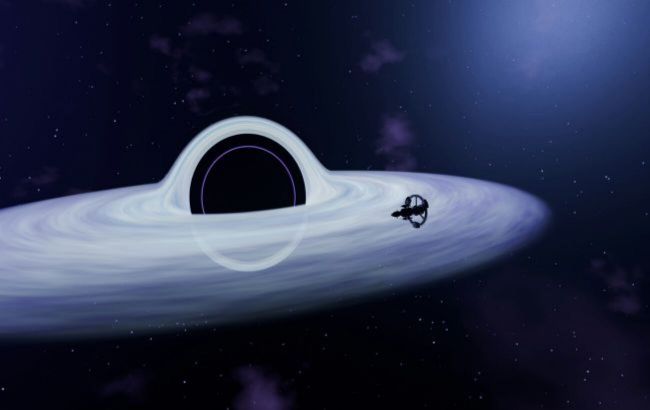 Researchers propose a new model for the formation of giant black holes (photo: Unsplash)
Supermassive black holes may turn out to be nurseries for huge numbers of planets. Astrophysicists suggest that dusty disks around active galactic nuclei create the conditions for entire populations of new worlds to form, according to SciNews.
Formation mechanism: From dust particles to stars
Computer modeling of a strongly magnetized active galactic nucleus disk showed that dust particles ranging from a few nanometers to fractions of a millimeter, entering from the interstellar medium, can clump together.
This triggers a process known as the "streaming instability":
- Dust concentrates into dense filaments that collapse under their own gravity
- These form objects of various sizes—from Earth-sized bodies to super-Jupiters
- In some cases, the mass is sufficient to cross the hydrogen-burning threshold, turning the object into a star.
Scientists estimate that a single such disk could contain tens of millions of planetary-mass objects. Their growth continues for 1 million to 10 million years—the typical active phase of a galactic nucleus—as they accumulate gas and smaller particles.
Researchers found objects up to 1,000 times more massive than Earth that consist entirely of dust, with some even approaching the mass of the Sun.
New pathway for forming stars and black holes
The process of forming these objects has been dubbed the active galactic nucleus channel. It demonstrates a fundamentally new way of forming stars—from the bottom up.
Unlike the conventional gravitational collapse of a large gas cloud (top-down), this process begins with small building blocks that later accumulate gas and grow into stars.
Newly formed stars can collapse into low-mass black holes.
Orbiting the central supermassive black hole, they behave like planetary embryos:
- They migrate and change their orbits
- They collide with one another
- They form much larger black holes, with masses hundreds or thousands of times greater than that of the Sun.
Researcher Bhupendra Mishra notes that the movement of such massive objects toward the galactic center would produce a powerful gravitational-wave signal.
In the future, these signals are expected to be detectable by the LISA space observatory of the European Space Agency (ESA), which is scheduled to launch in the mid-2030s.