China’s possible nuclear-style test shocks US: New details emerge

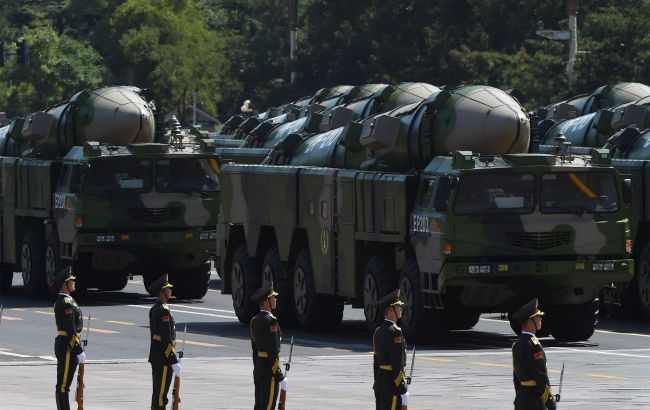 China may have concealed tests using a method known as disaggregation (Photo: Getty Images)
In early February, the US accused China of conducting underground nuclear tests in June 2020. New data now suggest that this may indeed have occurred, according to Reuters.
Read also: EU weighs nuclear rearmament amid concerns over Trump’s policy shift – Politico
At an event at the Hudson Institute, US Deputy Secretary of State Christopher Yeaw said a remote seismic station in Kazakhstan recorded an explosion with a magnitude of 2.75. It occurred on June 22, 2020, at the Lop Nur test site in western China, located 720 km from the seismic station.
“I’ve looked at additional data since then. There is very little possibility I would say that it is anything but an explosion, a singular explosion,” Yeaw said, adding that the data do not match mining explosions.
He also noted that the explosions do not resemble an earthquake at all.
“It is ... what you would expect with a nuclear explosive test,” the deputy secretary added.
At the same time, the Comprehensive Nuclear-Test-Ban Treaty Organization (CTBTO), responsible for detecting nuclear explosions, stated that existing data are insufficient to confirm the US official’s claims with certainty.
The PS23 seismic station in Kazakhstan is part of the CTBTO’s global monitoring system.
Robert Floyd, the organization’s executive secretary, said that the PS23 station recorded two very small seismic events 12 seconds apart on June 22, 2020.
According to him, the CTBTO monitoring system can detect events consistent with nuclear test explosions of 551 tons (500 metric tonnes) of TNT or more.
“These two events were far below that level. As a result, with this data alone, it is not possible to assess the cause of these events with confidence,” Floyd said.
Christopher Yeaw claims that China attempted to conceal the test using a method known as disaggregation, in which the device detonates inside a large underground chamber to reduce the force of shock waves transmitted through surrounding rock.
Reuters also noted that, like China, the US has signed but not ratified the Comprehensive Nuclear-Test-Ban Treaty. Under international law, both countries are obligated to adhere to the treaty.
What preceded this
Earlier in February, the US publicly accused China of a secret nuclear test, claiming that Beijing violated its obligations under the nuclear test ban.
The US statement came amid the expiration of the New START Treaty (START-3), which limited the nuclear arsenals of the US and Russia, and during active US efforts to advance a new, broader nuclear agreement involving China.
For a detailed analysis of the risks posed by the expiration of START-3, see the coverage by RBC-Ukraine.