Can AI really replace humans? Ukraine's tech expert explains changing workflow

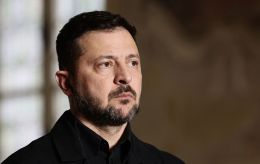
 AI can change the approach to work of various specialists (Illustrative photo: Getty Images)
Artificial intelligence has become part of the workflows of many Ukrainians. So, people have to adapt to new realities, says Danylo Tsvok, head of the AI direction at the Ministry of Digital Transformation of Ukraine, in an interview with RBC-Ukraine.
Key points
- AI does not replace but complements. Algorithms take over routine data checks, but the final decision and responsibility remain with humans.
- Transformation of professions. Specialists do not lose their jobs but adapt to collaboration with neural networks.
- Efficiency versus fatigue. AI can analyze massive volumes of documents 24/7 without losing quality, which is crucial for a country facing a workforce shortage.
Can AI replace humans in certain sectors?
The expert explained that the number of public services in the state is constantly increasing.
"Let’s put it differently. AI does not replace humans; it changes the approach to work. People will not disappear, they just adapt to new realities where processes become more efficient," Tsvok explained.
He added that talking about mass layoffs is incorrect.
"Today, the global standard for AI use assumes that the final decision is always made by a human," the expert said.
An algorithm does not provide 100% certainty (especially where the cost of error is high).
"AI takes on a huge amount of routine work and prepares a preliminary decision. A human checks it - okay or not," shared the Ministry of Digital Transformation representative.
For example, this applies to the medical field.
"In medicine, AI can analyze thousands of X-rays, but the doctor makes the diagnosis," Tsvok explained.
At the same time, he acknowledged one interesting fact.
"Studies show that with large datasets, AI makes fewer mistakes than even a super-professional doctor. Why? Because humans can get tired, and algorithms cannot," the specialist said.
This rule applies in any case, he added.
"Whether it’s legal expertise or processing citizen requests, AI works 24/7 with the same accuracy. Eliminating human fatigue while leaving the human as the main controller."
How AI is already simplifying state processes
"When it comes to AI, we need to talk about what truly has an effect. It’s about genuinely simplifying internal state processes and making services for citizens easier, faster, and more convenient. We clearly understand where AI is needed in the state and where it is not," Tsvok said.
He reminded that civil servants are often associated with a large state bureaucratic apparatus.
"It’s all about difficulties, a huge number of papers and documents," the expert added.
As an example, he cited the procedure for digital expertise of regulatory acts at the Ministry of Digital Transformation, which previously looked like this: "A lawyer manually read a document, for example, 80 pages, checking each paragraph for compliance with laws."
Such a process could take weeks.
"Now we use AI, which analyzes the document and gives its conclusion. We managed to reduce this period to 72 hours. Of course, a human reviews the conclusion, but the algorithm speeds up the procedure extremely," Tsvok shared.
The second case, according to him, is harmonizing Ukrainian legislation with EU standards.
"This is enormous work! Processing over 30,000 legal acts is a necessary step to become part of the European Union, which manually would have taken decades. We are working on an AI tool that instantly translates and analyzes European legislation," the expert said.
The third example he gave aims to automate 50% of support service requests.
"Today, AI handles over 90% of requests. The algorithm responds almost instantly - within 5 seconds, understands natural language and context. Humans only intervene in complex, specific cases that AI cannot cover. By this time, AI has already processed over a million user requests," Tsvok said.
What do people whose tasks are taken over by AI
The AI expert explained that since the number of public services and citizen requests is increasing, previously, it would have been necessary to infinitely scale the support team by hiring hundreds of new people.
"AI helped us reach a level where no request is left unattended. And without expanding the staff," he shared.
Regarding people, he said the ministry followed what is now called upskilling and reskilling.
"No one was laid off. On the contrary, specialists underwent transformation. Those who previously just answered questions have now become tutors for neural networks," Tsvok said.
He reminded that AI cannot develop on its own, so it constantly needs new knowledge and supervision.
"Now, former operators work as algorithm training managers. Part of the team was redirected to other areas within the Ministry of Digital Transformation ecosystem. The demand for specialists is enormous, so we just helped people master new roles," the official said.
He also reminded that Ukrainians are living in war, when resources are limited and most funds go to frontline needs.
"AI has become a tool of powerful assistance and efficiency for us. In a workforce crisis, which everyone is talking about now, claiming that algorithms will replace someone is impossible and completely inappropriate. We do not replace people, we allow them to do more important work while AI takes over the routine," the expert concluded.