California chemical plant blast threat forces mass evacuations

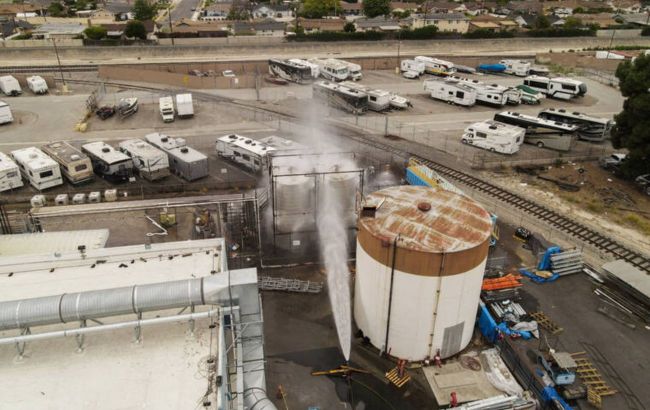 A tank with chemicals at a plant in a suburb of Los Angeles (Photo: Screenshot)
In Southern California, a tank containing hazardous chemicals began heating up rapidly, despite firefighters' attempts to cool it down. The risk of a massive explosion and the release of toxic substances remains critical, reports the Honolulu Star-Advertiser.
Firefighters discovered that a faulty container holding a toxic substance was heating up from the inside. This is happening despite constant spraying with water, so authorities ordered the evacuation of tens of thousands of people in Garden Grove.
Inside is methyl methacrylate — an extremely flammable substance used to produce plastics. Officials are warning of a possible rupture of the container. More than 26,500 liters of poison could spill into the air or onto the ground, threatening all living things.
Medics warn of health risks. Fumes from the chemical cause severe respiratory diseases. Currently, air quality monitoring has not detected dangerous concentrations outside the evacuation zone.
About 15% of residents refuse to leave their homes. This complicates police work. However, most people have already evacuated.
The incident occurred at the GKN Aerospace plant, which specialises in glassing for military aircraft. The facility is located just 48 kilometres from Los Angeles.
The owner company has already apologised. Plant representatives have brought in the best experts to solve the problem. Specialists are trying to find a chemical solution to stabilise the tank so that it does not explode.
Experts worked to neutralise a nearby tank with a capacity of nearly 56,700 litres.
Data from drones initially gave hope — the outer walls appeared stable. However, the actual sensor readings proved disappointing: the initial internal temperature was 25 degrees Celsius, and now it has risen to 32 degrees. Every hour, the liquid heats up by another degree.
Rescuers are already preparing for the worst-case scenario — building dams and levees around the plant. This is intended to contain the liquid in the event of a leak.