Burning units and power blocks: Reuters reports consequences of strike on Moscow oil refinery

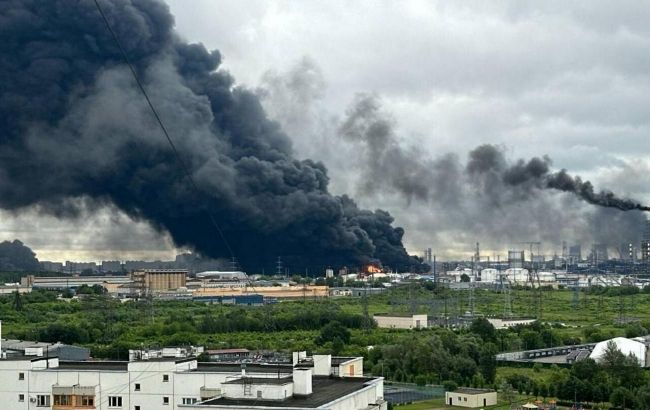 Photo: attacked Moscow oil refinery (t.me/exilenova_plus)
Agency sources said that the combined Euro+ oil refining unit, commissioned in 2020 as part of the refinery’s modernization program, was damaged as a result of the strike.
In addition, some auxiliary power units, inter-unit pipelines, and secondary processing facilities connected to Euro+ were also damaged. Storage tanks for petroleum products were hit and caught fire.
Reuters notes that in 2024 the Moscow oil refinery processed 11.6 million tons of crude oil (about 230,000 barrels per day), producing 2.9 million tons of gasoline, 3.2 million tons of diesel fuel, and 1.3 million tons of bitumen.
What is the Euro+ unit?
Euro+ is a key processing unit at the refinery that combines several stages of oil refining within a single production cycle.
It handles primary crude processing, purification of petroleum products from impurities, and the production of high-octane gasoline components.
The unit replaced a number of outdated technologies and accounts for a significant share of the plant’s capacity for producing gasoline, diesel fuel, and other petroleum products. Due to its role in the refinery’s operations, Euro+ is considered one of its most critical facilities.
Attack on Moscow, June 18
Moscow was attacked by drones overnight and in the morning. One of the key targets was the Moscow oil refinery in the Kapotnya district.
Numerous videos of the aftermath have been shared on social media, showing a direct hit on one of the refinery’s storage tanks and a large-scale fire at the facility.
Ukrainian President Volodymyr Zelenskyy confirmed that the Defense Forces struck the Moscow oil refinery for the second time in a week. According to him, the strike serves as a signal to Russia that the war should be brought to an end.