Bioplastic homes and fuel from air: AI-powered microbe could help colonize Mars

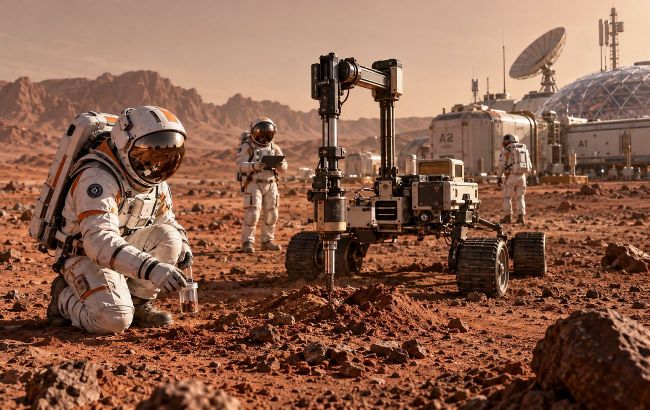 First step toward terraforming Mars achieved (Image: RBC-Ukraine)
Scientists have engineered a microbe that can turn toxic Martian soil into raw material for bioplastic production. The genetically modified organism, sPL.001, was developed by Pioneer Labs to operate in conditions on the Red Planet, according to Space.
Turning toxic soil into building materials
One of the main obstacles to growing plants and using local resources on Mars is the presence of perchlorates — toxic salts that are poisonous to most Earth organisms.
To tackle this problem, scientists took Earth microbes capable of synthesizing bioplastic and gradually exposed them to an artificially created Martian environment.
"On Mars, nature will do the same jobs for us that she does on Earth — create fertile soil, shelter, oxygen and food. Mars has all the raw materials for life in abundance," said Erika DeBenedictis, CEO of Pioneer Labs.
Today, Pioneer Labs is announcing our first step towards terraforming Mars.
— Erika Alden DeBenedictis (@erika_alden_d) September 22, 2026
With equipment that fits in just a single rocket launch, we can convert Martian dirt, water, and air into enough building materials to construct a small city on Mars.
To do it, we made the first… pic.twitter.com/IOacNinJkg
Through artificial selection, scientists developed the sPL.001 strain, which adapted to the toxins and learned to synthesize polymers suitable for 3D printing and constructing protective structures.
Ecosystem safety and mission efficiency
The organism requires a special bioreactor equipped with heating and mixing systems to survive. The reactor protects it from extreme temperatures, radiation, and low atmospheric pressure.
Because the microbe cannot photosynthesize and requires nitrogen supplied in the form of acetate, it cannot survive in the open Martian environment.
This effectively rules out the risk of accidentally contaminating Mars with Earth-based biological material.
According to the scientists, using the microbe could make it possible to fit all the equipment needed to construct a small settlement into the payload of a single rocket.
In the future, similar biotechnologies could also be used on Earth to combat the effects of climate change and manufacture materials in extreme environments.
Read also: DSP satellites retired: US closes 50-year chapter on nuclear surveillance