Artificial life one step closer: Scientists create cell that copies DNA and divides

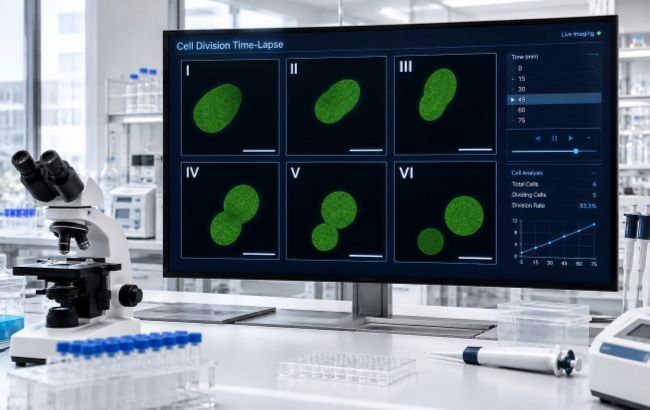 Bioengineers create artificial cell capable of reproducing itself (collage: RBC-Ukraine)
Scientists have created an artificial cell capable of performing certain functions of living organisms. The discovery could pave the way for new biotechnologies, but it also raises questions about where the boundary between living and nonliving matter lies, according to a study published on the bioRxiv preprint server.
From concept to reality
Developing SpudCell took several years and required numerous experiments.
The artificial cell consists of a membrane made of fat molecules that encloses a watery environment containing 36 genes and special proteins.
The scientists' main achievement is that the SpudCell can not only produce proteins but also copy its own DNA and divide to create new cells.
The researchers acknowledge that the replication process was far from perfect: the cell's genome is divided into seven circular segments (plasmids), and the cells cannot produce ribosomes on their own, requiring a constant supply of nutrients from outside.
Nevertheless, the very fact that a structure assembled from nonliving components can divide and pass on genetic material significantly raises the bar for research into minimal cells.

Fluorescence microscopy of a SpudCell during division. The six frames show the cell elongating, forming a constriction, and splitting into two daughter cells (source: Kate Adamala)
Read also: AI trained to modulate human brain activity to help restore vision
Biotic project: Future of bioeconomy
To accelerate the field's development, Kate Adamala, a biologist at the University of Minnesota and creator of SpudCell, and her Stanford colleague Drew Endy launched the Biotic initiative.
Their goal is to bring researchers together on a single platform to drive global change by 2050.
The researchers have outlined several ambitious goals for the project:
-
Fully replacing petroleum-based products, from jet fuel to synthetic fabrics, with chemicals produced using bioengineered organisms
-
Decentralizing the production of medicines and food
-
Creating specialized cells that can function inside a patient's body to deliver targeted therapy.
Where is the boundary of life?
Despite the remarkable results, SpudCell's creator does not yet consider it fully alive. The reason is that it is not sufficiently stable and can complete only a few division cycles before the process stops.
Meanwhile, the scientific community continues to debate whether such laboratory constructs qualify as living organisms.
Scientists are also closely watching safety concerns. The project authors emphasize that the new technologies are designed from the outset with protective mechanisms, safeguards, and "kill switches" to prevent any unforeseen risks to ecosystems.
Read also: Scientists explore purpose behind equipping robots with living cell brains