Scientists explore purpose behind equipping robots with living cell brains

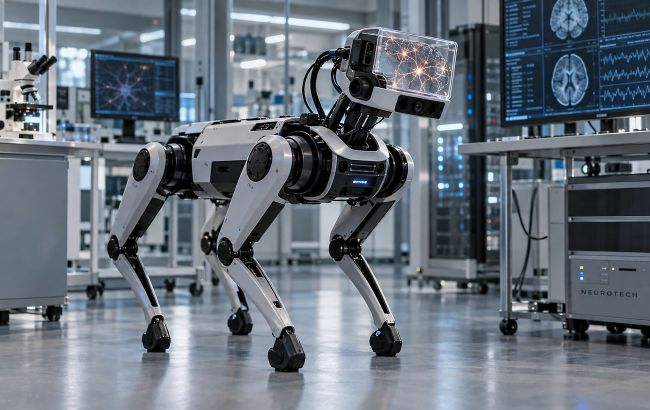 Living neurons learn to control a robot dog (image: RBC-Ukraine)
Scientists from the Australian company Cortical Labs have created a robot dog controlled by a biological processor made of living neurons. According to a recent study published on the arXiv preprint server, lab-grown brain cells were placed directly onto a chip equipped with electrodes.
How does a biological chip with living neurons work?
Scientists explained that living neurons could serve as the foundation for computer chips, potentially proving more efficient than traditional silicon processors. The human brain consumes significantly less energy than modern AI systems and adapts far better to unfamiliar conditions.
The Australian team grew neurons directly on the surface of a microchip and equipped it with electrodes to enable the bidirectional transmission of electrical signals.
As a result, the activity of a small cluster of cells was successfully translated into the physical movement of a robotic dog.
Specialized feedback loops continuously adjust the device's direction, helping it navigate to a designated point on a simple map.
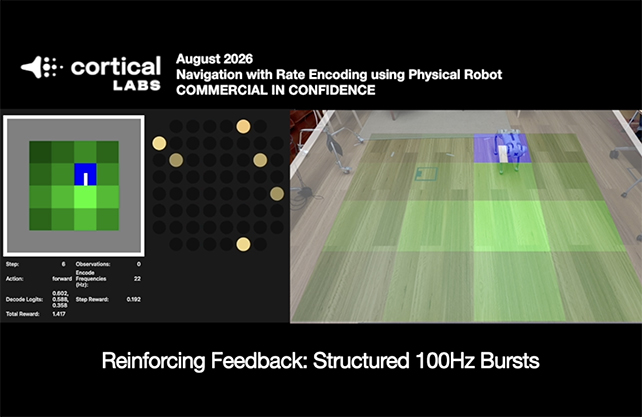
Feedback loops with electrical signals were used to guide the robot to its target (diagram: Cortical Labs)
Joint research with Honda and virtual testing
Earlier, Cortical Labs demonstrated how lab-grown neurons could perform computational tasks, notably playing the classic video games Pong and Doom.
Now, the company aims to push this technology beyond the confines of the virtual world. To this end, it has partnered with the Honda Research Institute Europe.
As part of this collaboration, researchers conducted an extended experiment within a virtual environment, where the living chip was tasked with seeking rewards on a basic grid. Over the course of more than 4,000 hours of continuous interaction, the scientists tested nearly 1,300 distinct signal combinations.
Daniel Tanneberg, a senior research scientist at Honda, emphasized that utilizing living cells as a computational substrate unlocks immense potential for the adaptability and energy efficiency of future intelligent agents.
According to the researchers, while modern robots already excel at running or executing complex acrobatic maneuvers, they still struggle with higher-order decision-making. They find it difficult to adapt when their surroundings change abruptly, which is precisely the problem the "living" chip is designed to solve.
Future prospects and key challenges
Currently, biological chips are in their nascent stages of development and do not yet boast high processing speeds or perfect accuracy.
However, in the future, such bio-hybrid robots could operate in hazardous or remote environments, as well as provide personalized assistance to humans, continuously learning in the process.
The primary challenge for engineers lies not merely in growing cells on silicon, but in establishing reliable methods of interfacing with these biological systems.
Scientists need to learn how to train them consistently, scale up the chips for more complex tasks, and understand exactly how living neurons store information and form memories.