AI trained to modulate human brain activity to help restore vision

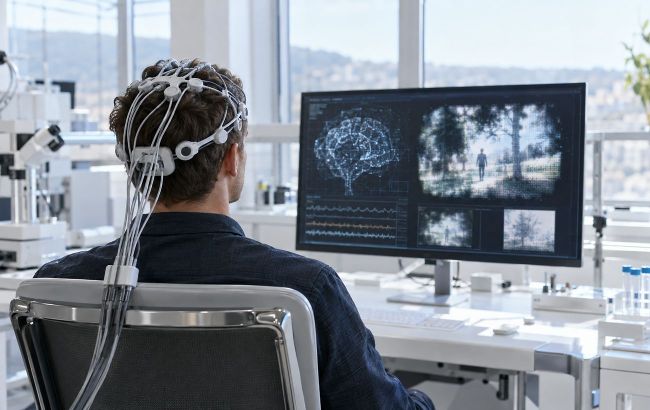 AI takes bionic vision to the next level (image: RBC-Ukraine)
Scientists have trained artificial intelligence to control electrical brain stimulation, enabling blind individuals to regain their sight. This new technology allows for the formation of clearer visual images while consuming significantly less energy, according to a study published in the journal Neuron.
Successful case studies
An international research team from the US, Switzerland, and Spain employed deep learning algorithms to control an implant in a 27-year-old man who had lost his vision due to trauma.
A matrix of 96 electrodes was temporarily implanted into his visual cortex.
Researchers explain that the device delivers electrical impulses, bypassing the damaged optic nerve. Consequently, the patient perceives phosphenes -flashes of light and outlines - which could eventually be assembled into a cohesive visual image.
Why the brain matters more than the electrical signal
The primary challenge in this development is that the visual cortex responds to impulses non-linearly. While engineers aim to use electrodes like pixels on a screen, the brain constantly alters its state, and adjacent electrodes interfere with one another.
Nevertheless, scientists highlight several key advantages of the AI-driven approach:
- The neural network predicts the brain's response to various stimulation patterns.
- The model accounts for background brain activity prior to each pulse.
- The system produces clearer visual images using lower electrical currents.
- The implant simultaneously stimulates neurons and reads their feedback signals.
During the trials, the patient described the perceived flashes' brightness, size, shape, and color, which enabled the AI to precisely calibrate subsequent algorithms.
Path to personalized bionic vision?
According to the researchers, this technology will serve as a lifeline for individuals who lost their vision in adulthood due to trauma, chronic conditions, or hereditary eye diseases.
At the same time, scientists emphasize that an effective visual prosthesis cannot operate on a fixed template. Artificial intelligence must continuously analyze the unique neural responses of each individual and adjust the stimulation in real time.
Currently, this technology stands as a successful proof of concept, laying the groundwork for future commercial bionic eyes.