Artemis II astronauts heading back to Earth after historic Moon flyby

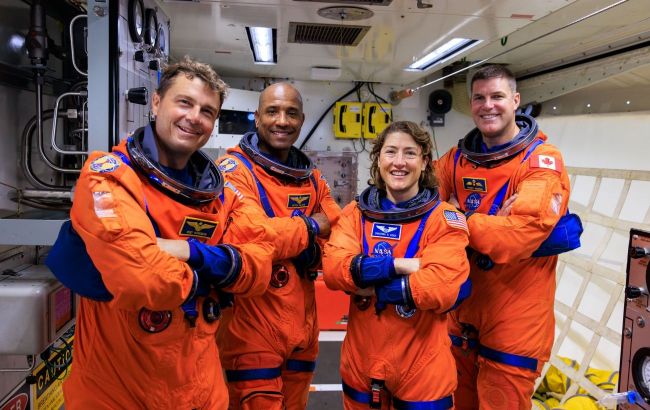 Photo: Four astronauts approach the Moon for the first time in 50 years (nasa.gov)
This week, humanity successfully returned to the Moon. The crew of NASA’s Orion spacecraft, part of the Artemis II mission, orbited Earth’s satellite and is now returning home.
RBC-Ukraine reports on key facts and highlights from NASA’s lunar mission.
Key points:
- Historic flight: NASA sent its first crewed mission to the Moon in over half a century. On April 1, the Orion spacecraft launched with four astronauts on a 10-day journey.
- Unique crew: For the first time, the Moon mission included a woman, an African American, and a Canadian astronaut.
- New distance record: During the flight, the Artemis-2 crew traveled 406,778 km from Earth, breaking the Apollo 13 mission record from 1970.
- No landing: This mission’s goal was a lunar flyby and critical testing of the spacecraft’s systems in deep space, not a Moon landing.
- Next steps: This flight serves as a key test ahead of NASA’s planned return of humans to the lunar surface in 2028, with the ultimate goal of reaching Mars.
What is known about the Artemis-2 mission
Artemis-2 is NASA’s first crewed test flight to the Moon in over 50 years. The mission launched on April 1 from Kennedy Space Center. That day, NASA’s launch vehicle successfully sent the Orion spacecraft on a 10-day journey to the Moon.
Mission goal: Four NASA astronauts are testing the Orion spacecraft systems. This is crucial for future deep-space missions and the establishment of a permanent lunar base.
Mission crew:
- Commander: Reid Wiseman
- Pilot: Victor Glover
- Mission Specialist: Christina Koch
- Mission Specialist: Jeremy Hansen
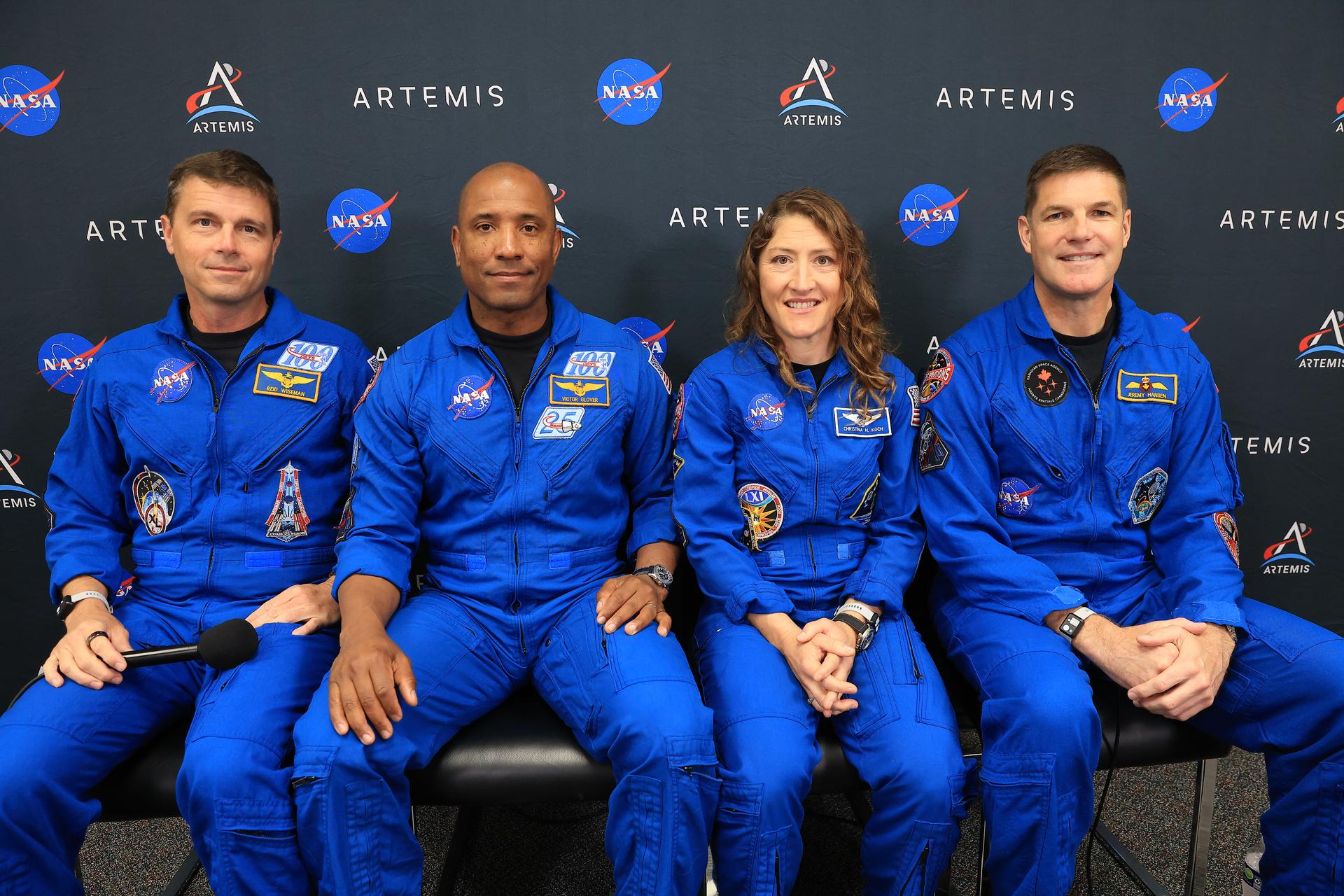 Photo: Artemis-2 crew consists of four astronauts (nasa.gov)
Mission plan
- Launch and orbit insertion: NASA’s heavy-lift SLS rocket placed the Orion spacecraft and its crew into Earth orbit.
- System checks in orbit: Orion performed maneuvers to reach a high Earth orbit. The crew had roughly 23 hours to test Orion’s systems near Earth fully.
- Manual piloting test: Orion detached from the upper stage and used it as a target to practice manual piloting, maneuvering, and rendezvous operations.
- Trajectory to the Moon: The final major engine burn sent Orion on a free-return trajectory. Lunar gravity began dominating over Earth’s gravity on the fifth day of the flight.
- Moon flyby: The crew approached the Moon at distances between 6,400 km and 9,600 km. While flying over the far side, astronauts lost contact with Earth for about 40 minutes, but captured unique photos and videos.
- Return to Earth: The Earth-Moon gravitational system naturally guided Orion back. Five hours before reentry, the service module detached from the crew capsule.
- Atmospheric reentry: The capsule entered dense layers of the atmosphere. The heat shield absorbed the impact of superheated plasma, reaching temperatures of around 1,650°C, temporarily cutting off communication with the crew.
- Splashdown: A system of 11 parachutes gradually slowed the capsule from over 200 km/h to a safe 27 km/h. After landing in water, inflatable cushions stabilized the spacecraft for safe crew exit.
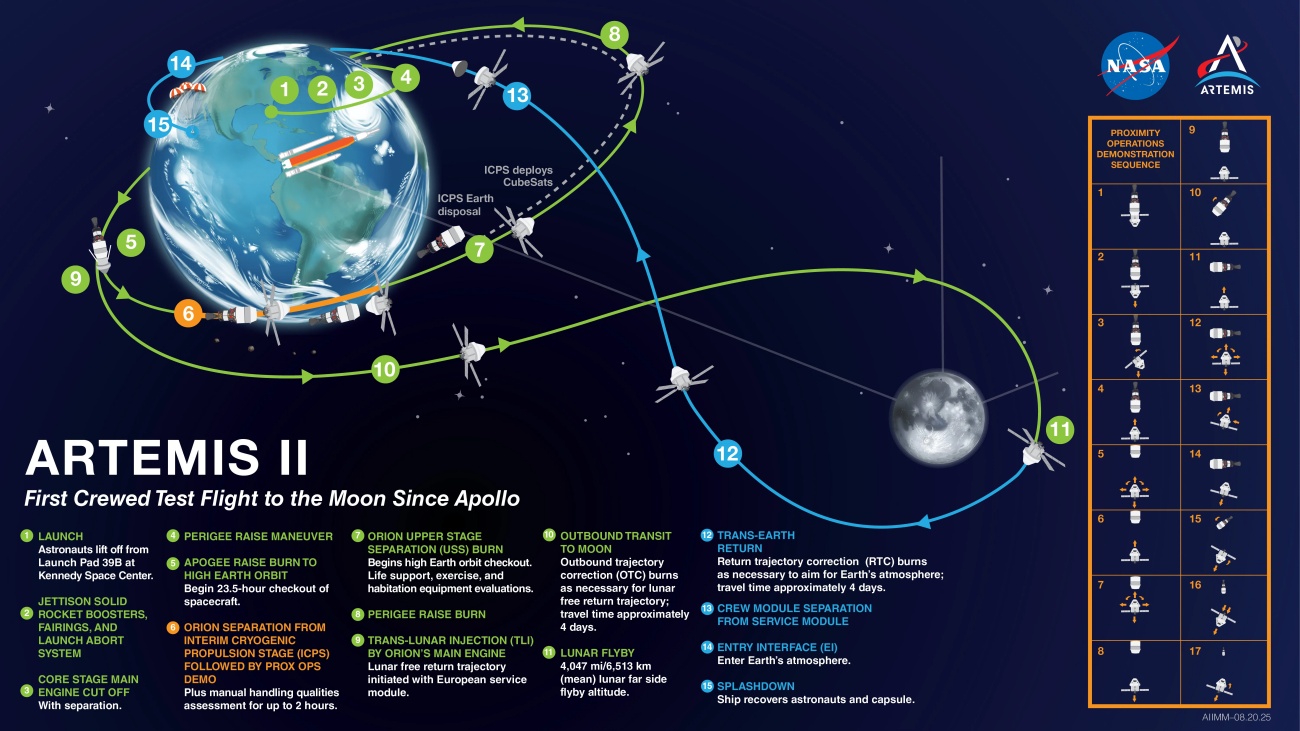 Photo: Flight plan of the Artemis-2 mission (nasa.gov)
Interesting facts about the mission
Fact #1: Victor Glover will make history as the first African American to fly around the Moon, according to Forbes. This mission is also a landmark for Christina Koch and Jeremy Hansen, who became the first woman and first Canadian to embark on such a deep-space journey.
Fact #2: During the flight, the crew broke the Apollo 13 distance record from 1970, traveling 406,778 km from Earth. Despite the historic achievement, astronaut Jeremy Hansen emphasized that future generations should aim to surpass it as soon as possible.
Fact #3: Immediately after setting the record, the crew made a touching request to Earth: to allow them to name two new lunar craters, The Guardian reports.
- One crater would be named Integrity, after their capsule.
- The other would be named Carroll, in memory of commander Reid Wiseman’s wife, who passed away from cancer.
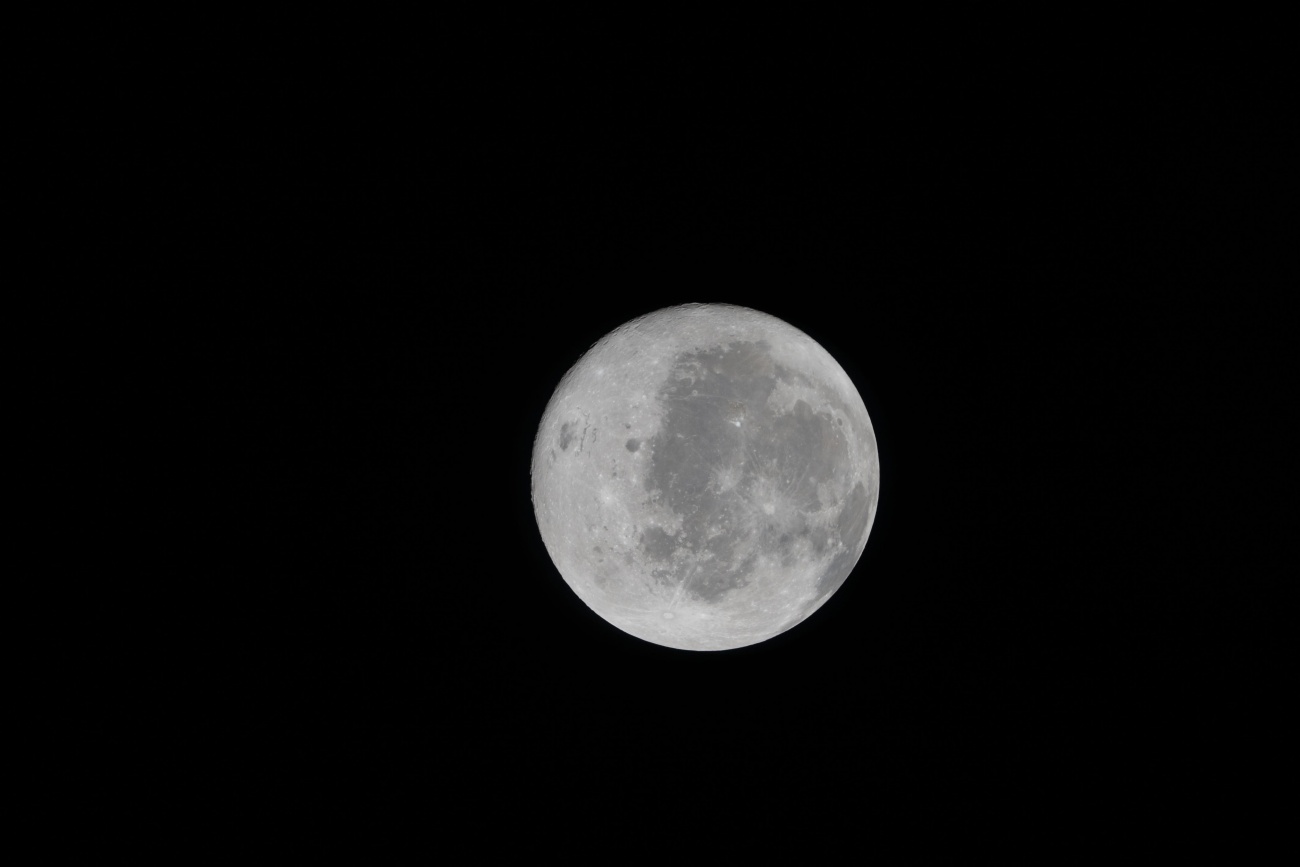 Photo: NASA shows the far side of the Moon photographed by the Orion crew (nasa.gov)
During the request to Mission Control, Reid Wiseman became emotional, and the entire crew shared a heartfelt hug. NASA confirmed that the crater-naming proposals will be submitted for official approval to the International Astronomical Union.
Fact #4: During the Moon flyby, the crew listened to a message from Jim Lovell, the legendary Apollo 13 commander. He recorded it two months before his death last year: “Welcome to my old stomping grounds. It’s a historic day, but don’t forget to enjoy the view while you work.”
To honor him, the crew brought a silk patch from the Apollo 8 mission, which once flew to the Moon with Lovell. Displaying the relic before the crucial flyby, Reid Wiseman emphasized that carrying it was a great honor for the team.
Fact #5: Not everything went smoothly. On the way to the Moon, the crew had problems with the space toilet. A frozen ventilation pipe temporarily prevented waste ejection.
To clear the ice blockage, astronauts had to maneuver the spacecraft to face the Sun, activate heaters, and use backup plastic containers. NASA confirmed that the system now works normally, and these plumbing issues did not affect the historic lunar flyby trajectory.
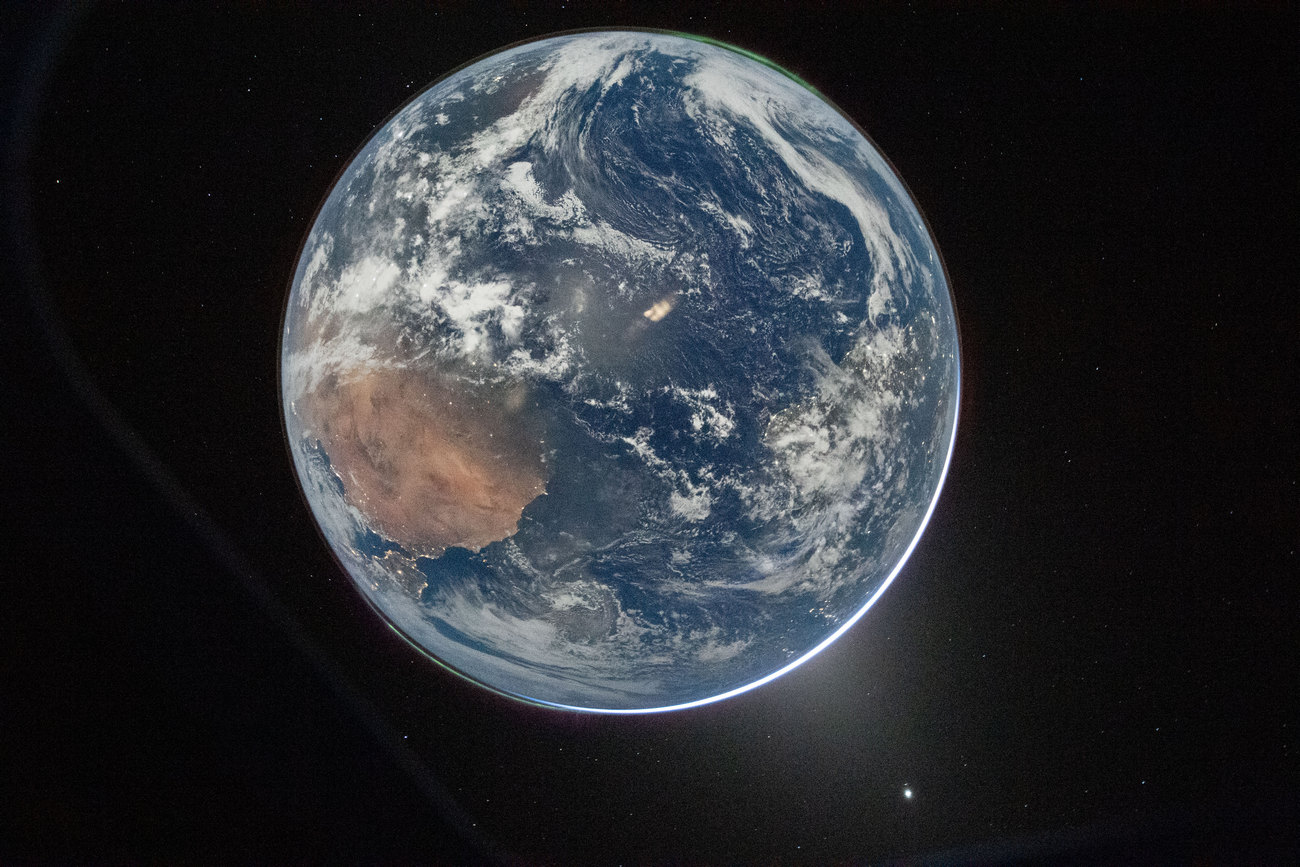 Photo: Orion crew captures first Earth images in over half a century (nasa.gov)
NASA’s next plans
Humans are not expected to return to the Moon before 2028, but lunar missions are planned to become regular after that. Current NASA plans include:
- Artemis-3 (2027) – Module testing: A demonstration mission in low Earth orbit to test commercial landers from SpaceX and/or Blue Origin.
- Artemis-4 (early 2028) – First landing: The historic return of humans to the Moon’s surface.
- Artemis-5 (late 2028) – Start of regular flights: Using the standard SLS heavy-lift rocket, NASA aims to make lunar expeditions roughly annual.
Moon as a stepping stone to Mars
NASA’s ultimate goal for crewed spaceflight remains Mars. Studying the Red Planet could reveal insights about Earth’s past and future, and possibly answer whether we are alone in the universe.
In this context, current Moon missions are a critical preparation stage: Earth’s satellite serves as a testing ground for advanced technologies that will eventually enable astronauts to undertake deep-space journeys and reach Mars.
You may also be interested in: